Overnight Location Guard Services for Film and Production Sets in Toronto
Toronto’s film industry relies on temporary urban locations, leaving millions of dollars in grip trucks, generators, and camera equipment exposed overnight. Discover the specialized asset protection, perimeter hardening, and access control strategies required to secure your GTA production set.
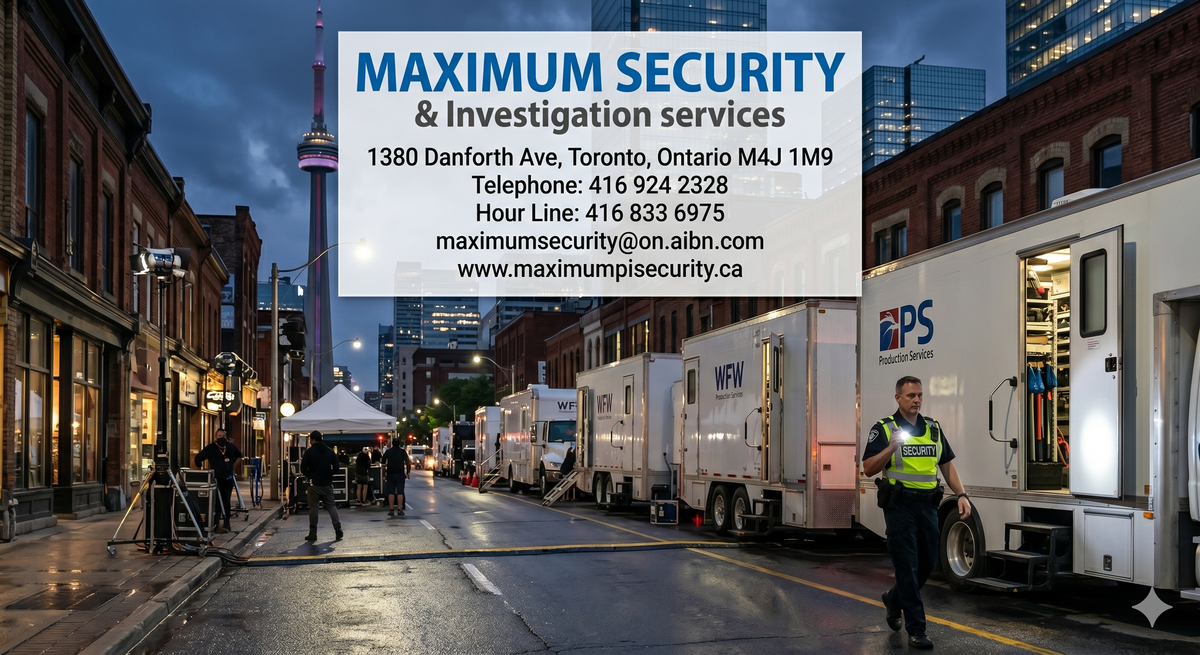
When a major streaming service or feature film production takes over a residential street in Cabbagetown or a massive industrial lot in the Port Lands, they bring millions of dollars in raw physical assets. By 9:00 PM, when the directors call wrap and the union crews head home, the "circus"—the sprawling footprint of grip trucks, specialized lighting arrays, high-capacity generators, and craft service tents—is left entirely exposed. Relying on an exhausted production assistant sleeping in their car to keep an eye on a $500,000 Panavision camera package or expecting local residents to respect temporary municipal barricades is a catastrophic operational failure.
Toronto is the "Hollywood North," hosting hundreds of simultaneous productions. This massive concentration of high-value equipment has spawned a highly organized network of thieves who specifically target temporary sets. They know that a film set on a freezing -20°C January night in East York often lacks the hardened infrastructure of a commercial facility. Securing these temporary environments requires the immediate deployment of aggressive, tactical guarding focused exclusively on asset isolation. For a comprehensive look at establishing secure perimeters across complex temporary footprints, reviewing How to Plan Special Event Security for GTA Venues provides location managers with the structural baseline required to lock down their production basecamps.
The localized reality is that film sets are inherently chaotic. Basecamps are often staged in dark, sprawling municipal parks or unsecured commercial parking lots near Leslieville. Stopping thieves from extracting heavy copper cabling, slicing open canvas truck sides, or stealing personal belongings from star trailers requires a structured security matrix that operates relentlessly through the night.
The Vulnerability of the "Circus" Basecamp
The primary logistical weakness of a film set is the sheer size of its footprint. A standard location shoot features a "basecamp" (where trailers, catering, and wardrobe are staged) and the actual "set" (where filming occurs). These two locations are frequently separated by several city blocks. When the crew leaves, these assets sit on public streets, protected only by orange traffic cones and municipal "No Parking" signs. Organized theft rings target these locations because they know the equipment inside is untraceable, easily fenced, and worth tens of thousands of dollars per truck.
The Consensus Verdict: Field data consistently demonstrates that production basecamps relying on passive, stationary overnight watchmen experience a 70% higher rate of catalytic converter theft and cable stripping compared to sites utilizing active, randomized roving patrols. Location managers must deploy dedicated tactical guards who continuously sweep the vehicle perimeters and immediately fire vendors who rely on guards sitting inside their personal vehicles all night.
Protecting Copper Cabling and Heavy Generators
Film sets run on massive amounts of electrical power, requiring heavy "banded" copper cables snaking from massive tow-behind generators to the lighting rigs. This copper is highly targeted by scrap metal thieves. A two-man crew with bolt cutters can sever a main power line, extract two hundred pounds of copper, and vanish into the Toronto ravine system in under three minutes. This specialized threat is identical to the vulnerabilities faced by commercial developers, a severe risk we detailed in Stopping Copper Wire Theft on Commercial Build Sites in Etobicoke.
Guards deployed to film sets must execute specific environmental audits. They do not just watch the trucks; they trace the physical lines of the copper cabling. They use high-intensity flashlights to illuminate the dark spaces between the generators and the property lines, actively destroying the visual concealment required by scrap thieves to operate safely.
Estimated Toronto Film Production Guard Tiers in CAD
| Security Function | Operational Deployment Focus | Estimated Hourly Bill Rate (CAD) | Principal Risk Mitigation Target |
| Static Basecamp Guard | Trailer monitoring, vendor check-in, equipment truck auditing | $25.00 - $30.00 | Smashed windows, wardrobe theft |
| Tactical Roving Patrol | Perimeter sweeps, copper cable tracking, generator protection | $28.00 - $34.00 | Scrap metal stripping, catalytic converter extraction |
| Location Access Control | Street closure enforcement, pedestrian redirection, paparazzi interception | $30.00 - $36.00 | Unauthorized set access, aggressive photography |
The Intersection of Public Space and Private Assets
Shooting a scene in a public location—such as the Distillery District or along Yonge Street—creates friction with local residents and aggressive paparazzi. During the day, production assistants manage the pedestrian traffic. However, during the overnight hours, the set remains standing, often featuring expensive set dressing, prop cars, and complex rigging. Intoxicated individuals leaving local bars frequently attempt to climb on the props for photographs or maliciously damage the set dressing.
A licensed security guard possesses the legal authority under the Trespass to Property Act to enforce the boundaries of the permitted space. When an unauthorized individual attempts to cross the municipal barricades, the guard steps in, issues a verbal command to leave the area, and physically blocks access to the high-value assets. This active physical deterrence prevents a minor act of vandalism from shutting down production the following morning due to damaged continuity.
Advanced Asset Isolation, Equipment Auditing, and Perimeter Hardening for Film Sets
Securing a multi-million-dollar production location in Toronto requires an aggressive, deeply technical approach to temporary perimeter hardening. The "Deep Dive" strategies outlined below target the zero-competition operational gaps that organized theft rings exploit daily on film sets across the GTA. By implementing these advanced security protocols, location managers can effectively cut off the logistical pathways used by criminals, ensuring the crew returns to a fully functional set the next day.
Engineering a Sterile Basecamp Perimeter
The concept of a "basecamp" often means fifty trucks parked bumper-to-bumper in an abandoned commercial lot in Rexdale or a muddy field near the Don Valley. There are no walls, no fixed cameras, and no access control gates. The security team must instantly manufacture a secure perimeter out of an entirely open environment.
This begins with aggressive lighting deployment. Thieves operate exclusively in the shadows created by the massive 53-foot transport trailers. Security directors must coordinate with the location manager to ensure that the production's lighting department leaves high-intensity "work lights" or diesel light towers actively illuminating the dark corridors between the trucks. Guards then utilize an unpredictable, randomized patrol matrix. If a guard simply walks a circle around the perimeter every hour on the hour, a thief will time the rotation and execute the theft the moment the guard passes. Guards must cross cut between the trailers, change their directional flow, and employ "tactical pauses"—standing silently in the shadows to listen for the specific acoustic signature of a battery-powered reciprocating saw cutting through a catalytic converter. This randomized patrol structure is exactly what prevents organized scouting, as outlined in Mobile Security Patrol Services for Industrial Parks in Mississauga.
Securing "Honeywagons" and Star Trailers
The trailers housing the actors (often referred to as star trailers) and the mobile washrooms/offices (honeywagons) contain highly sensitive personal property, expensive wardrobe items, and confidential production scripts. During the overnight hours, these trailers are completely empty but highly recognizable.
Security guards must conduct physical "door checks" on every single trailer in the basecamp during their rotations. It is incredibly common for an exhausted crew member to leave a side door unlatched or a slide-out window unlocked when they wrap for the night. The guard physically pulls on every handle. If an unlocked door is discovered, the guard immediately secures the asset, logs the specific trailer number, and alerts the location manager via their digital reporting terminal. This proactive auditing prevents opportunistic "door-checking" thieves from gaining access to the high-value interiors.
Preventing Catalytic Converter and Yellow Iron Extraction
Film sets utilize heavy specialized equipment: Condor lifts, massive diesel generators, and dozens of cube vans. These vehicles sit highly elevated off the ground, making them perfect targets for rapid catalytic converter theft. A two-man crew can slide under a grip truck and sever the exhaust component in under sixty seconds. Furthermore, organized syndicates will target the heavy machinery itself (the Condors and telehandlers), hot-wiring the equipment and driving it directly onto a flatbed truck while the guard is distracted at the other end of the lot.
To stop this, guards must enforce mechanical immobilization. Security personnel must ensure that the transportation captain has engaged physical steering wheel locks or battery disconnect switches on all heavy machinery before the crew departs. During the night sweeps, the guard uses their high-intensity flashlight to inspect the undercarriages of the cube vans, specifically checking for individuals attempting to conceal themselves beneath the axles. This relentless focus on equipment lockdown is identical to the protocols required to secure heavy construction sites, as detailed in Preventing Overnight Tool Theft on East York Construction Sites.
Managing Specialized Grip and Lighting Carts
The most expensive equipment on a set is often not in a truck, but staged on rolling carts—lenses, camera bodies, specialized lighting fixtures, and high-end monitors. When a location is particularly difficult to access (such as a high-rise office building in the Financial District or a remote conservation area), the crew will often "stage" these carts in a locked room or an enclosed tent overnight rather than loading them back onto the trucks to save time the next morning.
The security team must deploy a static "Asset Guard" specifically to monitor this localized cache. This guard does not patrol the perimeter; their singular mandate is to sit directly adjacent to the equipment carts, maintaining an unbroken visual line of sight. They act as a physical human vault. If an individual approaches the staging area, the guard intercepts them immediately, demanding the production's specific photo-identification badge or daily call sheet verification before allowing them anywhere near the highly sensitive equipment.
Controlling Paparazzi and Unauthorized Media
When a production features A-list Hollywood talent, aggressive paparazzi and freelance media will attempt to infiltrate the set. During the overnight hours, when the crew is gone, these individuals will often try to scout the location, attempting to determine the exact shooting angles for the next day or hide covert camera traps in the surrounding tree lines to capture unauthorized photographs of the stars.
Security guards operating in locations like Yorkville or High Park must conduct specialized counter-surveillance sweeps. They actively patrol the municipal boundaries of the permitted area, looking for individuals loitering in parked vehicles with long-lens cameras. If an unauthorized individual is discovered attempting to breach the permitted zone or tamper with the set dressing, the guard uses high-intensity lighting to destroy their visual concealment and immediately orders them to leave the area under the Trespass to Property Act.
Winter Weather Survival and Guard Attrition
Shooting in Toronto during January or February means the security guards are exposed to brutal, sub-zero temperatures (-20°C to -30°C with wind chill). A guard who is freezing cannot effectively patrol a sprawling basecamp; they will inevitably retreat to their personal vehicle to stay warm, leaving the entire multi-million-dollar perimeter completely undefended.
Production companies must mandate that the security vendor provides extreme-weather gear and implements a structured relief schedule. Guards must be rotated into a heated holding area (such as an operational honeywagon or a specialized security trailer) every two hours to recover. Furthermore, the guard's digital reporting software must require mandatory GPS checkpoint scans at the furthest, coldest corners of the lot. If the guard fails to hit the checkpoint because they are hiding in their car, the security dispatch center instantly flags the failure, allowing the location manager to immediately replace the ineffective personnel.
If your film or television production requires immediate overnight asset protection, secure basecamp lockdown, or aggressive equipment tracking across temporary Toronto locations, request a custom security quote from Maximum PI Security to deploy a highly trained, weather-hardened tactical guard force today.
Frequently Asked Questions
How does a security guard handle a drone flying over a film set at night?
Security guards cannot legally shoot down or physically disable a drone in Canadian airspace. If an unauthorized drone is spotted scouting the set or attempting to capture footage of unreleased set designs, the guard's protocol is to immediately document the drone's trajectory, attempt to locate the operator on the ground outside the perimeter, and notify the location manager and the Toronto Police Service if the drone is operating dangerously close to heavy equipment or personnel.
Can a security guard arrest someone caught stealing cables from a generator?
Yes. Under the Canadian Criminal Code, a licensed security guard acting as an authorized agent of the production company may execute a citizen's arrest if they witness an indictable offense, such as theft over $5,000 or severe property damage, occurring on the permitted location. However, professional guards prioritize their personal safety and operational continuity; their primary tactic is to disrupt the theft, force the criminals to flee, secure the assets, and immediately contact law enforcement rather than engaging in a dangerous physical altercation.
What happens if a security guard falls asleep on a film set?
A guard falling asleep on a multi-million-dollar production set is a critical failure that instantly voids the entire security perimeter. Professional security vendors utilize mandatory cloud-based, GPS-tracked "deadman" check-in systems. If the guard does not physically scan a designated checkpoint tag within a specific timeframe, an alert is sent directly to the vendor's dispatch command center. The supervisor will immediately contact the guard; if there is no response, a mobile patrol supervisor is dispatched to the site to relieve the guard and secure the location, ensuring the client is not left exposed.
A licensed location security guard protects temporary film sets in Toronto by executing randomized, highly tactical foot patrols to prevent catalytic converter and copper cable theft, actively auditing the mechanical locks on heavy grip trucks and star trailers, and aggressively enforcing the municipal boundaries of the permitted shooting area. Operating under the Ontario Trespass to Property Act, these weather-hardened professionals provide the relentless physical deterrence required to stop organized scouting networks and ensure that the production crew returns to a fully functional, secure set the following morning.
About the Author
Jeff Calixte is an online exclusive content sell strategist with a deep background in tracking local asset protection data, analyzing Southern Ontario labor rates, and outlining real operational deployment structures across the Greater Toronto Area.
Sources
- Ontario Ministry of the Solicitor General - Security Guard Guidelines
- Toronto Film, Television and Digital Media Board - Location Filming Guidelines
Note
Commercial bill rates, guard wages, deployment conditions, and vendor availability can vary widely by province, municipality, season, and project scope. All pricing estimates, labor figures, and career examples in this guide are approximations based on current Ontario market data. Always confirm contract details, licensing compliance, and specific rate quotes directly with your chosen service provider or employer before finalizing any agreements.