Stopping Copper Wire Theft on Commercial Build Sites in Etobicoke
Copper theft spikes during electrical rough-in phases on Etobicoke developments. Discover the exact 2026 commercial bill rates, physical site lockup protocols, and live guarding tactics to eliminate metal theft.
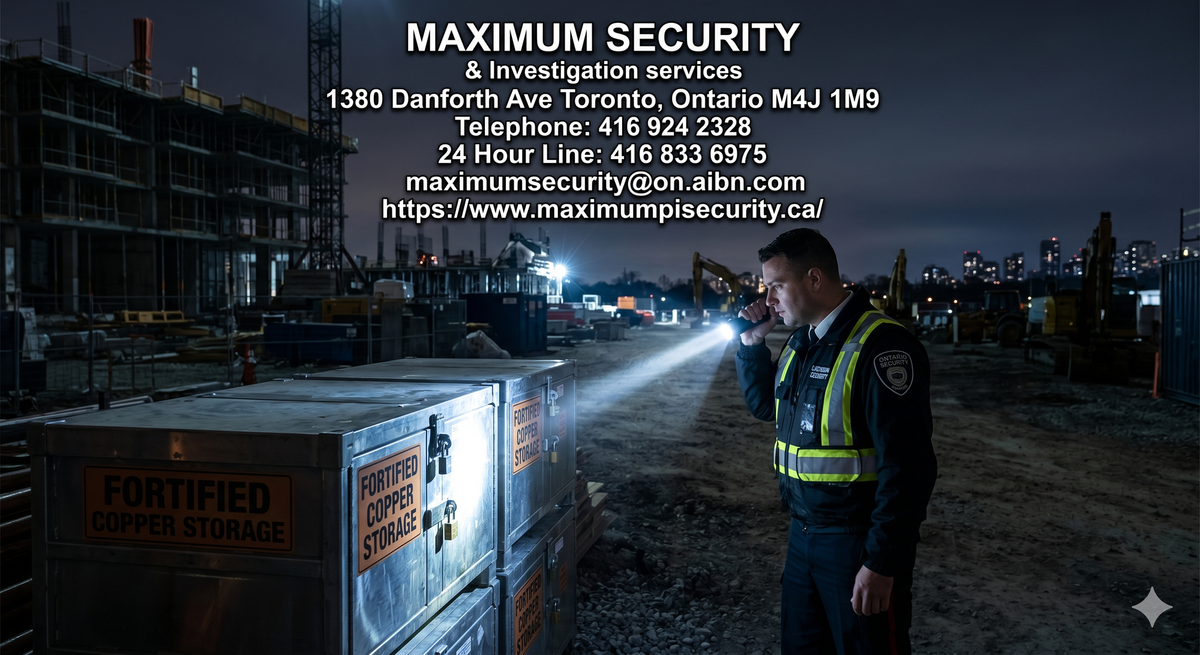
Securing commercial developments, high-rise residential properties, and industrial infrastructure expansions across Etobicoke—ranging from multi-tower builds near the Humber Bay Shores waterfront to dense commercial developments along The Queensway, Kipling Avenue, and Islington Avenue—demands strict risk mitigation protocols. Among the diverse security challenges faced by project managers and electrical sub-trades, the overnight theft of copper wire and plumbing brass represents one of the most severe threats to project timelines and operating capital. Copper theft spikes significantly during the electrical rough-in phases of construction when hundreds of thousands of dollars in uninstalled spools, bulk feeders, and raw mechanical infrastructure sit exposed within open-perimeter structures.
Relying on basic perimeter fencing, padlocked entry gates, or unmonitored wireless alarm sensors leaves a site vulnerable to organized metal salvage rings. These criminal operations target Southern Ontario construction corridors specifically to exploit high scrap-metal resale values. For a general contractor or mechanical project supervisor, preventing these targeted incursions requires a layered approach to physical site defense, including strict material handling workflows, secure container engineering, and professional on-site security deployments. Aligning asset protection frameworks with verified industry data protects your financial margins and prevents costly trade downtime.
The Operational Logistics of Organized Copper Theft in the GTA
Copper wire theft across Etobicoke is rarely an impulsive property crime executed by uncoordinated opportunists. Field data reveals that organized scrap-metal tracking networks systematically scout commercial builds during daylight operational hours. They monitor delivery manifests, identify exactly which floors are undergoing electrical rough-ins, map camera blind spots, and evaluate the response times of site staff. When the trades clear out at tool-drop, these teams execute highly coordinated midnight sweeps, utilizing specialized tools to harvest premium industrial wire assets quickly.
Consensus Analysis: Off-Site Storage Yards vs. On-Site Fortified Containers
Project supervisors often debate whether to transport high-value copper inventory off-site to a centralized logistics hub every evening or rely on temporary on-site containment solutions.
The Verdict:
- Avoid This: Transporting bulk copper spools off-site daily via sub-trade service vehicles. The continuous labor overhead, transport logistics, and secondary handling risks rapidly drain operating margins. Furthermore, transport vans parked overnight in residential driveways or local hotel parking lots become prime targets for secondary vehicle break-ins.
- Buy This: Establish an on-site, heavily fortified containment compound located directly within the primary line of sight of your central guard station. Store all high-value spools inside reinforced steel sea containers fitted with interior dual-deadbolt locking mechanisms, eliminating external vulnerabilities and forcing scrap thieves to execute loud, time-consuming cutting attempts to breach the inventory.
Calculating the True Economic Overhead of Copper Breaches
The real financial damage of a copper wire breach extends exponentially past the raw commodity invoice value of the stolen scrap metal. When an organized group breaches a commercial structure along Highway 401 or near Sherway Gardens to rip out installed electrical feeders, they cause catastrophic collateral damage to the building's infrastructure. Thieves routinely cut through live conduits, destroy main distribution panels, and tear down finished drywall tracks simply to harvest a few hundred kilograms of bare bright copper.
When the electrical sub-contractors and primary trade crews arrive on-site at 6:30 AM, progress grinds to an immediate halt. If main power feeds are severed, the entire project loses operational capabilities, impacting elevators, cranes, and temporary heating units. Because specialized union trades and sub-contractors operate under strict labor agreements across the GTA, the primary developer remains financially responsible for daily trade wages even when zero forward progress occurs. A single major copper wire extraction can trigger multiple days of complete electrical downtime, costing a commercial build thousands of dollars in unrecoverable labor outlays.
| Cost Allocation Factor | Standard Unsecured Staging Compound | Fortified On-Site Security Deployment |
| Material Replacement & Scrap Invoice | $18,500 - $35,000 (CAD) | $0.00 (Breach Deterred) |
| Collateral Infrastructure Repair Costs | $12,000 - $28,000 (CAD) | $0.00 (No Damage Sustained) |
| Sub-Trade Labor Downtime (2 Full Days) | $16,000 (CAD) | $0.00 (Continuous Execution) |
| Builders' Risk Insurance Deductible | $5,000 (CAD) | $0.00 (No Insurance Claim) |
| Project Milestone Penalty Assessment | Applicable under prime contract | $0.00 (On-Schedule Hand-off) |
| Total Estimated Project Impact | $51,500 - $84,000+ (CAD) | $0.00 |
Furthermore, multiple high-value claims submitted to commercial builders' risk insurance carriers can cause annual premium rates to escalate significantly or lead to the complete cancellation of structural coverage policies. If the remediation and re-wiring work pushes the project timeline past critical municipal occupancy hand-off deadlines, the primary developer faces heavy liquidated damages clauses. Sourcing professional, proactive security guarding services is mathematically superior to absorbing the severe operational and financial fallout of an unprotected infrastructure yard.
To understand how these risk management frameworks align with broad provincial regulatory codes and overall project budgeting, project procurement teams should review our comprehensive 2026 construction site security guidelines for GTA contractors to establish compliant site defenses.
Engineering a Comprehensive Copper Protection Framework
Eliminating copper scrap theft requires an active, physical layout strategy that begins at the initial site planning phase and shifts dynamically as building construction advances upward.
1. Hardening Storage Staging with Recessed Lock Technology
If your site relies on standard commercial storage trailers or yellow job boxes secured by exposed shackle padlocks, your high-value wire assets are highly vulnerable. Scrap metal syndicates cut through standard brass and laminated steel shackle loops in under thirty seconds using battery-powered reciprocating saws or heavy bolt cutters.
To properly secure valuable inventory, project managers must mandate that all on-site storage vaults and shipping containers utilize case-hardened steel locks protected by fully recessed, anti-pry housings (commonly known as "puck locks"). These specialized enclosures completely shield the lock body, neutralizing manual cutting, prying, and grinding tools. Contractors looking to fortify local tool storage setups can review our specific regional blueprint on preventing overnight tool theft on East York construction sites for advanced locking standards and container layout blueprints.
2. Vertical Staging and Environmental Controls
As commercial towers and multi-unit developments scale vertically, leaving wire inventory on lower, uncompleted ground floors creates a significant vulnerability. Cooper theft syndicates routinely back transport trucks directly up to open main floor decks to load raw materials quickly.
To counter this tactic, implement strict material routing protocols. Utilize on-site cranes or heavy material hoists to transport all high-value wire spools to elevated upper concrete decks at the end of the day shift. Staging inventory above the third floor makes it physically impossible for thieves to execute a quick load-and-drive operation, forcing them to spend significant time attempting to move heavy materials down stairs or open elevator shafts. For sites experiencing elevated rates of malicious property damage or unauthorized youth access during these framing and layout phases, combining these material workflows with the defensive frameworks in our guide on dealing with vandalism at Scarborough commercial build sites ensures perimeters remain highly defended.
3. Deploying Full-Time Static Guarding and Perimeter Controls
Sprawling commercial developments along high-volume transport corridors in Etobicoke require an uninterrupted physical security presence to counter organized property crime. A licensed, professional static security guard stationed on-site throughout overnight and weekend windows ensures your valuable electrical components remain under continuous visual monitoring.
The guard manages access gates, verifies incoming trade manifests, and conducts regular perimeter checks to ensure fencing panels have not been compromised. For project teams evaluating alternative mobile security frameworks across residential developments or low-density parcels, studying our detailed analysis on hiring live guards vs. mobile patrols for Vaughan residential developments outlines critical procurement metrics.
Structuring the 2026 Sourcing Budget for Compliant Protection
Acquiring external security guard coverage requires a clear understanding of commercial agency pricing across Southern Ontario. General contractors often confuse the hourly entry-level guard wage with the final commercial invoice rate billed by a fully insured security business. In 2026, a legitimate, compliant security agency must operate under the strict guidelines of the Private Security and Investigative Services Act (PSISA), pricing contracts to cover substantial corporate infrastructure, including multi-million-dollar commercial general liability insurance, WSIB clearings, vehicle fuel overhead, and mandatory supervisor dispatch networks.
For an active commercial build or a plaza renovation project in Etobicoke, contractors should budget for the following commercial agency bill rates:
Commercial Security Guard Tiers & Hourly Client Bill Rates (GTA)
| Guard Tier | Coverage Specification | Commercial Hourly Client Bill Rate (CAD) | Optimal Project Application |
| Tier 1: Basic Static Guard | Overnight perimeter observation, fire watch logs, gate locks, and digital incident reporting. | $38.00 - $48.00 / hr | Small-scale residential builds, contained infill lots, and low-risk urban developments. |
| Tier 2: Premium Access Control | High-traffic daytime gate management, sub-trade manifest logging, delivery verification, and safety compliance enforcement. | $45.00 - $58.00 / hr | Major mid-rise/high-rise condo projects, heavy infrastructure builds, and sprawling commercial plazas. |
| Tier 3: Dedicated Mobile Patrol | Randomized interval vehicle sweeps, perimeter fence integrity checks, and rapid alarm response integration. | $65.00 - $90.00 / hr (or $45 - $75 per individual site visit) | Multi-phase housing subdivisions, vacant land holding zones, and distributed municipal roadwork sites. |
Hiring an organization that quotes rates significantly below these commercial baselines—such as $22.00 to $25.00 per hour—is a direct indication that the provider is cutting critical compliance corners, leaving your business exposed to massive legal vulnerabilities. Understanding the foundational legal frameworks outlined in construction site security guard requirements in North York can protect your business from these severe compliance failures.
If your active commercial project, residential tower build, or industrial asset yard in Etobicoke requires an unyielding line of defense to eliminate copper theft exposures, establishing professional protection is straightforward. Project superintendents and property developers can easily connect with verified field operators to request a custom security quote from Maximum PI Security to deploy high-visibility assets, manage primary access gates, and secure valuable capital assets against overnight liabilities.
Regulatory Enforcement and Liability Under the PSISA
Sourcing private security guard forces for an active development property requires strict adherence to Ontario provincial regulations to insulate the primary contractor from severe civil liability and regulatory penalties. Under the Private Security and Investigative Services Act, every individual performing security, gate watch, or property patrol duties must hold an active Ontario Security Guard Licence card.
Some builders attempt to save money by paying off-duty laborers cash to sit in a vehicle and watch materials overnight. This practice introduces massive legal risks. Unlicensed workers lack the formal training required to manage trespassers properly under the Trespass to Property Act (TPA). If an unlicensed worker gets into a physical altercation with a copper thief and sustains an injury, your commercial liability insurance provider will likely invalidate your entire policy due to a breach of risk warranties. Your business will face immediate workplace safety investigations, heavy provincial fines, and potentially devastating civil lawsuits. For sites requiring heavy equipment tracking and physical perimeter guarding, reviewing specialized overviews like protecting heavy machinery from cargo theft in Mississauga construction zones is an essential step for any procurement team.
Nitty-Gritty Copper Theft Realities
How do scrap metal syndicates manage to liquidate thousands of dollars in stolen copper wire so quickly without being caught?
Organized copper theft rings bypass standard local recycling tracing mechanisms by establishing relationships with illicit scrap yards or transport brokers who operate outside standard regulatory frameworks. They utilize specialized mechanical stripping machines to strip insulation off wires within hours of a site breach, transforming distinct commercial wire products into generic, un-trackable "bare bright" copper commodities. This material is then packed into shipping containers or integrated with large commercial scrap shipments, making physical tracking exceptionally difficult for local police divisions once the metal clears the site perimeter.
What should an overnight security guard do if they discover a vehicle loaded with copper wire attempting to exit the site after hours?
If a guard encounters an unauthorized vehicle or a subcontractor’s truck attempting to transport bulk wire spools out of the site during non-operational hours, the absolute protocol is immediate gate containment and manifest verification. The guard must deny exit access, instruct the driver to remain stationary, and instantly contact the project superintendent to verify the material release authorization. If the driver attempts to force their way past the perimeter or abandons the vehicle, the guard must prioritize personal safety, document the suspect's physical description and license coordinates via a mobile reporting application, and immediately dispatch the Toronto Police Service.
Can a general contractor legally install live electric wiring loops to deter wire thieves?
No. Installing active, non-regulated electrical current loops or booby-traps designed to deliver physical shocks to intruders is a severe violation of both the Criminal Code of Canada and Ontario Occupational Health and Safety Act regulations. If a trespasser, subcontractor, or emergency first responder is injured or electrocuted by an intentional, non-compliant hazard on your property, the general contractor faces direct criminal negligence prosecution, massive corporate fines, and total civil liability. Stick to legal, highly effective physical deterrents like case-hardened puck locks, interior-facing lighting, and licensed guarding assets.

Frequently Asked Questions
Why does copper wire theft spike specifically during the electrical rough-in phase?
The electrical rough-in phase represents a period of maximum vulnerability because bulk wiring assets are distributed throughout the open structure of the build before finished walls and security doors are installed. Hundreds of meters of un-energized, exposed feeder cables are threaded through open studs, allowing thieves to cut and extract massive quantities of metal quickly with minimal physical obstruction.
Do security guards require specialized training to perform overnight fire watch duties on commercial sites?
Yes. When performing a mandated fire watch on a commercial development site, guards must understand the specific requirements enforced by the Ontario Fire Code. This includes maintaining continuous, detailed patrol logs, understanding the location of all temporary fire suppression equipment, and holding active certifications in Standard First Aid and CPR to manage emergency first-response scenarios until municipal emergency services arrive.
Should we utilize wireless security cameras with integrated strobe lights on Etobicoke build sites?
Wireless, battery-powered perimeter cameras equipped with motion-activated strobe lights and audible sirens can serve as an effective secondary layer of defense, provided they are integrated with a centralized monitoring station capable of verifying breaches in real time. Standalone units that simply flash without human verification or guard response mechanisms are quickly identified by experienced scrap syndicates, who bypass or disable them using simple physical obstructions.
About the Author
Jeff Calixte is an online exclusive content sell strategist with a deep background in tracking local asset protection data, analyzing Southern Ontario labor rates, and outlining real operational deployment structures across the Greater Toronto Area.
Sources
- Ontario Ministry of the Solicitor General - Private Security and Investigative Services Act Regulations
- Trespass to Property Act, R.S.O. 1990, c. T.21
- Ontario Occupational Health and Safety Act, R.S.O. 1990, c. O.1
Note
Commercial bill rates, guard wages, deployment conditions, and vendor availability can vary widely by province, municipality, season, and project scope. All pricing estimates, labor figures, and career examples in this guide are approximations based on current Ontario market data. Always confirm contract details, licensing compliance, and specific rate quotes directly with your chosen service provider or employer before finalizing any agreements.