Preventing Overnight Tool Theft on East York Construction Sites
Tool box lockbreakers are draining contractor budgets across the Danforth. Learn the exact high-security lock standards, site deployment blueprints, and 2026 commercial guarding rates to secure East York builds overnight.
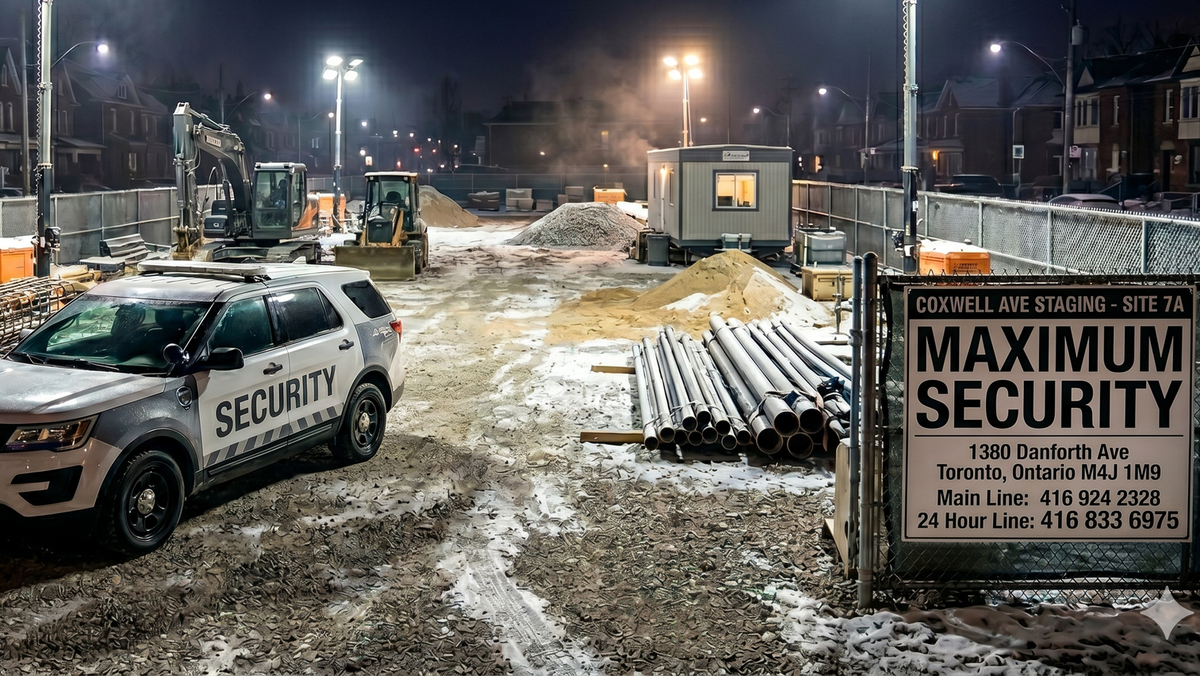
Securing active job sites across East York—particularly along the dense commercial stretches of the Danforth, near the transit hubs of Main Street, or within residential infill zones off Coxwell Avenue—demands an aggressive approach to physical asset protection. Small to mid-sized contractors routinely wake up to find their perimeters breached, tool boxes pried open, and high-value equipment cleared out. Unlike major multi-acre master-planned developments, compact urban build sites in East York feature tight staging footprints that force tools, generators, and raw materials closer to public sidewalks, making them prime targets for organized midnight theft rings.
Relying on residential-grade padlocks, standard chain-link fencing, or basic standalone motion-sensor alarms leaves an active project exposed to experienced thieves who can clear out an entire site within fifteen minutes. For a local general contractor or project superintendent, stopping these overnight losses requires adopting industrial-grade physical security standards, engineering strict tool-drop workflows, and integrating professional mobile patrol checks. By aligning your loss prevention tactics with proven field metrics, your business can avoid costly project downtime and keep operational budgets completely intact.
The Operational Mechanics of Urban Tool Theft
Overnight tool theft along the Danforth corridor is rarely the work of impulsive passersby. Field analysis across the Greater Toronto Area indicates that organized theft networks systematically target high-value assets during low-visibility hours. These groups drive standard cargo vans or pickup trucks with tinted windows, allowing them to pull directly up to site gates, cut through security obstructions, load heavy gear, and merge back into local traffic routes within minutes.
Consensus Analysis: Standard Steel Storage Boxes vs. Fortified Job-Site Vaults
Site supervisors frequently assume that locking heavy power tools inside a standard sheet-metal job box provides adequate security. However, standard toolboxes are routinely compromised using a standard 36-inch bolt cutter or a battery-powered angle grinder equipped with a metal-cutting disc.
The Verdict:
- Avoid This: Storing thousands of dollars in premium cordless tool kits, laser levels, and demolition hammers inside lightweight steel job boxes that rely on exposed external padlocks. Exposed shackle padlocks can be sheared off in less than thirty seconds with basic hand tools.
- Buy This: Transition all on-site storage to heavy-duty, recessed-shackle job vaults featuring internal deadbolt locking systems and integrated anti-pry reinforcement ribs. Ensure the vault is explicitly bolted directly to the concrete floor pad or chained securely to heavy machinery structures using case-hardened alloy transport chains.
Deep Dive: Calculating the True Cost of Lost Equipment
The financial damage of tool theft extends far beyond the immediate receipt cost of a replaced circular saw or rotary hammer. When an overnight breach occurs on an East York site, the primary contractor faces an immediate halt to their critical path schedule. If a mechanical or framing crew arrives at the job site at 7:00 AM only to discover that their specialized diagnostic gear or cordless tool arrays have been stolen, the day’s production is completely compromised.
Because skilled trades are in high demand and operate on strict schedules across the GTA, you cannot simply instruct a sub-contractor to wait around unpaid while you source replacement equipment from a supply outlet down on Justin Crescent. The project developer is generally stuck paying the daily trade labor wages despite zero forward progress being made on the build. A single day of complete trade downtime for a five-man framing crew routinely drains $3,500 to $6,000 in unrecoverable labor costs.
| Loss Factor | Basic Sheet-Metal Box Breach | Fortified Security Vault Setup |
| Direct Material Replacement Cost | $8,500 - $12,000 (CAD) | $0.00 (Deterred Attempt) |
| Trade Crew Downtime (1 Full Day) | $4,500 (CAD) | $0.00 (Normal Operations) |
| Insurance Deductible Outlay | $2,500 (CAD) | $0.00 (No Claim Filed) |
| Project Delay Penalty/Liquidated Damages | Applicable after milestone miss | $0.00 (Maintained Schedule) |
| Total Estimated Financial Impact | $15,500 - $19,000 (CAD) | $0.00 |
Furthermore, filing police reports with local divisions, coordinating with insurance adjusters, and paying high commercial deductibles further erodes the thin margins of an urban infill project. If the missing tools delay specialized inspections or structural pours, the contractor risks triggering steep liquidated damage clauses outlined in their prime contract. Investing in professional perimeter defense and advanced locking mechanics is a highly predictable, mathematically superior alternative to absorbing the heavy logistical fallout of an unsecured staging yard.
Designing an Ironclad Overnight Tool Protection Blueprint
Eliminating tool theft in dense urban neighborhoods requires a layered defense system that starts at the outer perimeter fence and extends down to individual equipment storage cases. For East York builders, implementing these structural adjustments before structural framing begins is vital to securing the site against intrusive approaches.
1. Perimeter Fortification and Choke-Point Engineering
Urban build sites are often squeezed between existing structures, forcing access gates close to public roads. Your perimeter fence must be constructed using heavy-gauge chain-link panels secured by robust ground anchors or concrete blocks, rather than loose sandbags. All fence interlocking clamps must face inward to prevent intruders from simply unscrewing the perimeter from the public side.
Furthermore, you must establish an unyielding high-visibility buffer zone. Position all high-value material containers and job-site vaults within the direct line of sight of street-facing lighting arrays. Thieves rely heavily on shadows; by illuminating your primary storage areas with high-efficiency LED floodlights directed inward, you remove the cover of darkness required to operate angle grinders or torch setups safely.
2. Implementing Case-Hardened Lock and Shackle Standards
If your site relies on cheap brass or laminated steel padlocks sourced from big-box retail outlets, you are essentially inviting asset loss. Intruders bypass these components effortlessly using standard hand tools.
To properly secure gates and storage containers, contractors must mandate the exclusive use of Boron-alloy or case-hardened steel padlocks featuring fully enclosed, hidden-shackle designs (often referred to as "puck locks"). These locks lack an exposed shackle arm, completely neutralizing bolt cutters, pry bars, and manual sawing attempts. Additionally, any security chains used on-site must utilize square-link configurations constructed from manganese-alloy steel, which deflects standard cutting edges and forces thieves to consume precious time and battery power attempting a breach.
Contractors looking to align their physical site defenses with broad provincial regulatory codes and overall budgeting metrics should review our core master manual on 2026 construction site security guidelines for GTA contractors to establish clear baseline protocols.
3. Integrating Randomized Mobile Security Patrols
When a project's budget cannot support a full-time, 12-hour static overnight guard deployment, integrating a dedicated mobile security patrol service is the most effective alternative. A mobile security unit does not remain on-site continuously; instead, a professional patrol officer in a marked security vehicle arrives at your East York project at completely randomized intervals throughout the high-risk window between 8:00 PM and 6:00 AM.
During each individual site visit, the patrol officer exits their vehicle to perform a rigorous physical inspection of your perimeter fence, manually test gate locks, check the integrity of your tool vaults, and ensure no unauthorized individuals are scouting the interior. The randomized nature of these checks completely disrupts the planning of local theft operations, as scout teams cannot predict when a security vehicle will turn off Coxwell Avenue and enter the staging area.
For developers seeking active on-site enforcement that addresses localized community issues and municipal compliance, tracking specific safety benchmarks like dealing with vandalism at Scarborough commercial build sites provides excellent context for structuring multi-site security protocols.
Commercial Procurement: Sourcing Verified Guarding Services
Acquiring external security guard coverage requires a realistic understanding of commercial agency pricing across Southern Ontario. General contractors often confuse the hourly entry-level guard wage with the final commercial invoice rate billed by a fully insured security business. In 2026, a legitimate, compliant security agency must operate under the strict guidelines of the Private Security and Investigative Services Act (PSISA), necessitating competitive pricing to cover substantial corporate infrastructure, including multi-million-dollar commercial general liability insurance, WSIB clearings, vehicle fuel overhead, and mandatory supervisor dispatch networks.
For an active infill project or a commercial strip renovation in East York, contractors should budget for the following commercial agency bill rates:
- Static Overnight Foot Patrol Guard (Tier 1): Billed at $38.00 to $48.00 per hour (CAD). This involves a dedicated guard stationed continuously on your property for a full 10-to-12-hour shift, executing continuous physical perimeter patrols and maintaining a digital incident logbook.
- Randomized Mobile Patrol Visits (Tier 3): Billed at $45.00 to $75.00 per individual site inspection (CAD). This option provides three to four completely unpredicted, thoroughly documented vehicle drop-by checks per night, presenting an outstanding balance of risk mitigation and cost containment.
If your urban project or mid-rise development along the Danforth demands immediate, unyielding protection against active theft rings, establishing a professional line of defense is simple. Project superintendents can seamlessly connect with proven local operators to request a custom security quote from Maximum PI Security to deploy high-visibility assets, secure primary tool vaults, and eliminate liability vulnerabilities before they trigger severe operational delays.
Critical Compliance Realities for On-Site Security
Deploying any form of physical security on an East York construction yard requires strict adherence to Ontario provincial regulations to prevent the primary contractor from facing heavy fines or civil liability claims. Under the Private Security and Investigative Services Act, every single individual performing security duties, access control, or overnight watch functions must hold an active Ontario Security Guard Licence card.
Some general contractors attempt to bypass this requirement by offering cash to a junior laborer or apprentice to sleep in their truck on-site overnight. This practice is extremely dangerous. Unlicensed individuals lack the legal training required to manage trespassers under the Trespass to Property Act (TPA). If an unlicensed worker engages in a physical altercation with a tool thief and sustains an injury, or uses improper force against a trespasser, your commercial liability insurance provider will likely invalidate your entire policy. The primary construction company will face immediate workplace safety investigations, massive financial fines, and severe civil lawsuits. Understanding these structural guidelines by reviewing specialized overviews like construction site security guard requirements in North York is an essential step for any procurement team.
Nitty-Gritty Tool Theft Answers
What should a site supervisor do if they find an angle-grinder attack in progress overnight?
If a remote camera feed or a mobile patrol officer detects an active tool theft in progress, the absolute protocol is to avoid direct physical intervention. Organized tool thieves frequently carry weapons, including pry bars, machetes, or bear spray, and will escalate to violence if cornered. The guard or monitoring supervisor must immediately retreat to a position of total safety and dial 911 to dispatch the Toronto Police Service, providing real-time tracking updates regarding the suspects' vehicle description and license plate coordinates.
Does my commercial insurance policy cover tools owned by individual sub-contractors?
In almost all standard commercial builders' risk policies across Ontario, tools owned personally by sub-contractors or individual tradespeople are explicitly excluded from the primary contractor's coverage. Sub-contractors are required to maintain their own tool floater insurance policies. However, when an overnight breach occurs, the primary contractor remains stuck with the resulting labor downtime costs. Implementing centralized, highly secure job vaults that sub-contractors can utilize collectively overnight protects your project schedule from grinding to a halt.
Can we legally use GPS tracking tags inside our primary tool vaults?
Yes. Embedding hidden GPS tracking tags (such as heavy-duty industrial asset trackers) inside major tool vaults, generators, and large equipment cases is a highly recommended practice across the GTA. If a vault is stolen or broken into, these trackers provide real-time location data directly to the Toronto Police Service. However, you should never attempt to track or recover stolen assets yourself; always hand the tracking data directly over to local law enforcement to execute a lawful recovery.

Frequently Asked Questions
What are the most common hours for overnight tool theft in East York?
Field data indicates that the vast majority of successful construction site breaches in East York occur between 11:00 PM and 3:30 AM. This specific window offers the lowest levels of local vehicular traffic along major thoroughfares like the Danforth, allowing theft vehicles to operate with minimal public visibility.
How can I secure heavy pull-behind generators that cannot fit inside a tool vault?
To secure large mobile machinery such as tow-behind generators, air compressors, or light towers, supervisors must employ case-hardened tongue locks and heavy wheel boots to prevent the equipment from being hitched to a suspect's vehicle. Furthermore, wrap a high-security manganese-alloy chain tightly through the wheel arches and lock it directly to a heavy excavator bucket lowered flat to the ground.
Should we use wireless motion-sensor alarms on urban infill sites?
Wireless, battery-powered site alarms equipped with integrated cameras can serve as a helpful secondary layer of defense, provided they are tied to a professional monitoring station that handles immediate police verification. Standalone sirens that simply flash or ring without active dispatch integration are generally ignored in dense urban environments and provide minimal real deterrence against experienced lockbreakers.
About the Author
Jeff Calixte is an online exclusive content sell strategist with a deep background in tracking local asset protection data, analyzing Southern Ontario labor rates, and outlining real operational deployment structures across the Greater Toronto Area.
Sources
- Ontario Ministry of the Solicitor General - Private Security and Investigative Services Act Regulations
- Trespass to Property Act, R.S.O. 1990, c. T.21
- Toronto Police Service - Commercial Break and Enter Prevention Standards
Note
Commercial bill rates, guard wages, deployment conditions, and vendor availability can vary widely by province, municipality, season, and project scope. All pricing estimates, labor figures, and career examples in this guide are approximations based on current Ontario market data. Always confirm contract details, licensing compliance, and specific rate quotes directly with your chosen service provider or employer before finalizing any agreements.