Cost Breakdown of 24/7 Concierge Services for Scarborough Condominiums
Scarborough condo boards face immense pressure to balance rising maintenance fees with essential resident safety. Discover the exact cost breakdown for 24/7 concierge security services, including hourly bill rates, hidden contract fees, and strategies to maximize community protection.
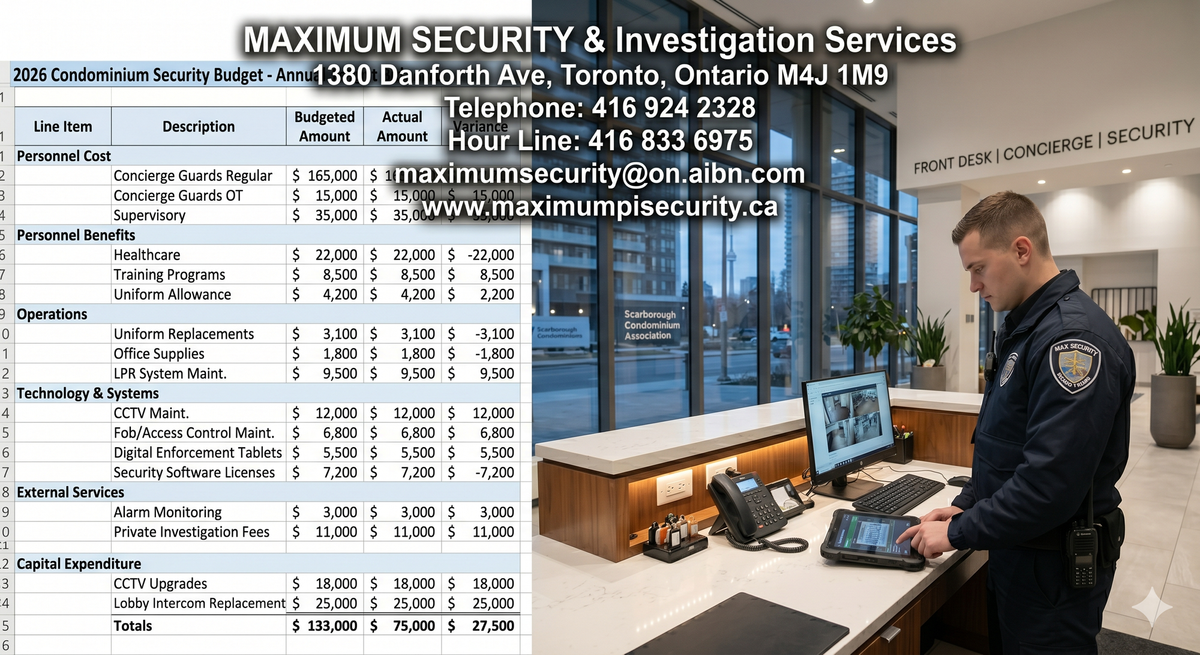
Scarborough’s residential skyline is evolving at an unprecedented pace. From the dense, towering high-rise clusters surrounding the Scarborough Town Centre (STC) to the rapidly expanding mid-rise communities along the Eglinton Avenue transit corridor and the waterfront properties near Guildwood, condominium living has become a dominant housing model in Toronto's east end. As these vertical neighborhoods grow in both size and density, so do the complex logistical and security challenges that property management groups and volunteer condo boards must navigate on a daily basis.
At the absolute center of a condominium's operational success is the front desk concierge. The concierge serves a vital dual mandate: they are the luxury hospitality face of the building, welcoming residents and managing complex parcel deliveries, while simultaneously operating as the primary physical firewall against unauthorized entry, organized property theft, and community disturbances.
However, as condo boards enter their 2026 budget planning cycles, they are met with a harsh financial reality. Inflationary pressures, aggressive minimum wage increases across Ontario, and soaring commercial insurance premiums have driven the cost of professional security services to historic highs. When a property manager presents the annual budget at the Annual General Meeting (AGM), the 24/7 concierge contract frequently stands out as one of the most expensive line items, second only to reserve fund contributions and municipal utilities.
To prevent resident outrage over skyrocketing maintenance fees, condo boards must understand exactly what they are paying for. Blindly accepting the lowest security bid or misunderstanding the crucial difference between a guard's hourly wage and an agency's bill rate leads to catastrophic operational failures, extreme guard turnover, and severe security breaches. This comprehensive guide provides a total, transparent breakdown of what 24/7 concierge security actually costs in Scarborough in 2026, where every single dollar goes, and how your board can optimize its security budget without sacrificing the safety of your community.
What is the Cost of 24/7 Concierge Services for Scarborough Condos?
In 2026, the baseline cost for a standard 24/7 concierge security service in a Scarborough condominium ranges between $254,000 and $306,000 annually. This translates to an hourly agency bill rate of approximately $29.00 to $35.00 per hour for 8,760 hours of continuous coverage. Premium deployments involving highly trained site supervisors or dual-guard setups during peak daytime hours can push the annual security budget to between $315,000 and $394,000. These figures account for direct guard wages, mandatory provincial burdens (WSIB, CPP, EI), corporate liability insurance, and the administrative overhead required to manage a Private Security and Investigative Services Act (PSISA) licensed team.
The 2026 Financial Landscape for Scarborough Condo Boards
Condominium boards in Scarborough are currently operating in a highly restrictive financial environment. The cost of maintaining an aging high-rise or establishing a solid reserve fund for a new build has never been more expensive.
When residents review their monthly maintenance fees, they demand tangible value. They expect the lobby to be spotless, the elevators to function flawlessly, and the concierge desk to be manned by a sharp, articulate, and highly capable professional. Unfortunately, many condo boards attempt to appease residents by artificially suppressing maintenance fees, leading them to aggressively cut the security budget to save face.
This is a devastating miscalculation. Scarborough is currently experiencing a massive surge in localized property crime. Recent data indicates that auto theft across the Scarborough corridor has spiked dramatically, with underground condominium parking garages acting as primary targets for organized theft rings. Furthermore, the explosion of e-commerce has turned condo lobbies into massive logistical hubs; a 300-unit building in Scarborough can easily receive over 200 packages a day. Managing this inventory, controlling access, and securing the garage requires premium personnel. Attempting to manage a modern Scarborough high-rise with a cut-rate security contract is a direct path to plunging property values and massive civil liabilities.
The Base Math: Calculating 24/7/365 Coverage Hours
Before diving into hourly rates, condo boards must understand the sheer volume of hours required to maintain a 24/7 front desk.
Providing continuous, unbroken coverage requires far more than just hiring a single guard. The security agency must recruit, train, and manage a dedicated team of personnel to cover day shifts, night shifts, weekends, and handle emergency sick-call replacements without ever leaving the desk empty.
- Hours in a Day: 24 hours
- Days in a Year: 365 days
- Total Annual Billable Hours: 8,760 hours
If your condominium requires a single concierge guard stationed at the desk 24 hours a day, your board will be billed for exactly 8,760 hours annually. If your massive multi-tower complex requires two guards on duty simultaneously during the busy daytime hours (for example, between 8:00 AM and 8:00 PM), those additional 4,380 hours must be factored directly into the overall operational budget.
The 2026 Hourly Bill Rate Breakdown for Condominium Concierges
In the commercial security industry, the term "Bill Rate" refers to the total hourly amount that the security agency charges the condominium corporation. It is critical to understand that this bill rate dictates the tier of service, the quality of the personnel, and the level of liability protection your building receives.
In the Scarborough market, compliant, PSISA-licensed security agencies typically offer three distinct tiers of concierge pricing:
Tier 1: The Entry-Level Greeter (Avoid This Category)
- Estimated Bill Rate: $25.00 to $28.00 per hour
- Annual Budget (8,760 hours): $219,000 to $245,280 (CAD)
- The Operational Reality: If a security agency quotes you a rate in this range, they are operating on razor-thin margins and paying their guards absolute minimum wage. In this tier, the guards view the job as a temporary stepping stone. Your building will experience massive turnover—seeing a different face at the desk every week. These guards frequently lack the conflict de-escalation training required to manage aggressive residents, and they will not possess the technical knowledge required to operate your complex fire alarm annunciator panel during a true crisis. Selecting this tier introduces severe life-safety liabilities to your condominium.
Tier 2: The Professional Licensed Concierge (Industry Standard)
- Estimated Bill Rate: $29.00 to $35.00 per hour
- Annual Budget (8,760 hours): $254,040 to $306,600 (CAD)
- The Operational Reality: This is the absolute standard for a well-managed Scarborough condominium. At this bill rate, the agency can afford to pay the guards a competitive living wage, ensuring long-term retention. A Tier 2 concierge is highly trained in white-glove customer service, strict access control procedures, and emergency fire panel management. They become a permanent, recognizable fixture in your community, learning the residents' names and establishing a deep understanding of the building's specific vulnerabilities. If you want to understand how to structure the rules for this tier, reading our deep dive on condominium concierge security management is essential.
Tier 3: The Tactical Concierge Supervisor (Premium)
- Estimated Bill Rate: $36.00 to $45.00+ per hour
- Annual Budget (8,760 hours): $315,360 to $394,200 (CAD)
- The Operational Reality: This tier is typically reserved for massive, multi-tower luxury complexes requiring a dedicated Site Supervisor. This individual does not just stand at the desk; they manage the entire security apparatus of the building. They audit the key control matrix, manage the scheduling of the secondary guards, execute complex investigations into amenity vandalism, and act as the direct liaison between the condo board, the property manager, and the local police division.
Agency Bill Rate vs. Guard Wage: Where Does the Money Go?
A frequent source of intense frustration at condo board AGMs is the discrepancy between the agency bill rate and the guard's actual take-home pay. A unit owner might loudly ask, "Why are we paying the security company $32.00 an hour when the guard is only making $20.00 an hour? Is the agency just pocketing a massive $12.00 profit for doing nothing?"
The answer is an emphatic no. The commercial security industry is heavily regulated by the province of Ontario, and the overhead costs required to field a legitimate, legally compliant guard are massive. The gap between the guard's wage and the bill rate is consumed by mandatory provincial burdens and required operational overhead.
Here is a highly realistic breakdown of where a $32.00/hour bill rate actually goes in 2026:
| Financial Component | Estimated Allocation per Hour | Description |
| Direct Guard Wage | $19.00 - $21.00 | The actual hourly pay the guard takes home before their own income taxes. |
| Provincial & Federal Burdens | $3.50 - $4.50 | Employer contributions for CPP, EI, WSIB premiums, and mandatory Vacation Pay accruals. |
| Corporate Insurance & Liability | $1.50 - $2.00 | Cost of maintaining $5M - $10M in Commercial General Liability and Errors & Omissions insurance. |
| Operational Overhead | $2.50 - $3.50 | 24/7 dispatch center costs, mobile supervisor support, guard training, and custom uniform procurement. |
| Agency Profit Margin | $2.50 - $3.50 | The actual net profit for the security company (typically a very tight 8% to 12% margin). |
If a condo board demands that the security agency lower their bill rate by $3.00, the agency cannot magically reduce their WSIB premiums or their insurance costs. The only place that $3.00 can be cut is directly from the guard's wage. When you cut the guard's wage, your best, most experienced concierges will instantly resign and walk across the street to a competing building that pays better, leaving your condominium entirely unprotected.
Hidden Costs and Contract Pitfalls to Avoid in 2026
When reviewing a 24/7 concierge security proposal, Scarborough condo boards must read the fine print carefully. A low hourly base rate can quickly balloon into a massive budget deficit if hidden fees are triggered throughout the year.
Statutory Holiday Premium Billing
Under the Ontario Employment Standards Act, security guards are legally entitled to time-and-a-half pay when working on recognized statutory holidays (such as Canada Day, Christmas Day, or New Year's Day). Legitimate security agencies pass this specific premium directly through to the client. With 9 to 10 statutory holidays a year in Ontario, condo boards must ensure they have buffered their annual budget by approximately $2,000 to $3,500 to cover these mandatory holiday billing spikes. Failing to budget for stat holidays will result in a painful budget deficit by the end of December.
Technology and Digital Software Fees
Modern condominium security relies heavily on digital technology. Gone are the days of paper logbooks that can be easily manipulated. Professional concierges utilize advanced digital tablets to log visitors, scan packages via barcodes, and write timestamped incident reports. Some security agencies include the cost of this software directly in their hourly bill rate, while others charge a separate "Technology Fee" ranging from $100 to $300 per month. Boards must clarify this structure before signing the contract so there are no surprise monthly invoices.
Short-Notice Emergency Coverage Penalties
If your building suffers a catastrophic flood in the basement and you require two extra security guards to be dispatched immediately to secure the hazard zone, agencies will frequently charge a "Short-Notice Emergency Rate" (often $45.00 to $60.00 per hour). This is due to the extreme logistical difficulty of pulling off-duty guards into active service with zero warning. Boards should establish exactly what constitutes an emergency rate and negotiate a cap on these fees during the initial contract phase.
Strategies to Optimize the Security Budget in Scarborough
If a Scarborough condo board is facing an intense budget shortfall, there are strategic ways to optimize the security apparatus without resorting to hiring a dangerous, cut-rate provider.
1. The Hybrid Model: Concierge Plus Randomized Mobile Patrols
If your complex currently employs two static guards overnight—one for the lobby and one to continuously walk the underground garage—you can achieve massive savings by switching to a hybrid model. Keep your premium, Tier 2 concierge stationed at the front desk 24/7 to manage the fire panel and front doors. Instead of paying for a second full-time static guard, contract a mobile security patrol service to execute randomized vehicle checks of your massive underground garage three times a night.
At approximately $45 per stop, this strategy provides highly aggressive, unpredictable deterrence in the garage while saving the corporation upwards of $50,000 annually compared to a second static guard. For insights on implementing this exact model, reviewing our breakdown of mobile patrol security for residential condominiums provides excellent operational context.
2. Leverage Access Control Technology to Reduce Burnout
Invest heavily in your building's physical access control systems to reduce the sheer administrative burden on the concierge. Implement a digital visitor registration app where residents can pre-register their guests' license plates directly from their smartphones. When the guest arrives, they scan a QR code at the vestibule, and the system automatically opens the door and registers their vehicle for parking enforcement. By automating these repetitive administrative tasks, the concierge is freed up to focus entirely on active security monitoring and intercepting malicious tailgaters.
3. Negotiate Multi-Year Contracts for Budget Stability
If your board is satisfied with your current premium security provider, do not put the contract out to tender every single year. Request a three-year lock-in agreement. In exchange for the long-term contract stability, the security agency will frequently agree to cap their profit margins and limit operational increases. While the bill rate will still rise slightly to match mandatory provincial minimum wage hikes, the agency will absorb minor overhead inflations, providing your board with highly predictable, stable budget forecasting for the duration of the term.
Why Cutting Costs on Concierge Security is a Devastating Mistake
Attempting to save $15,000 a year by switching to the absolute cheapest security bidder is the most dangerous decision a Scarborough condo board can make. The immediate financial fallout of poor security vastly outweighs the minor contract savings.
If a cut-rate guard falls asleep at the desk and an organized auto theft crew slips into your underground garage, stealing three luxury SUVs in one night, the resulting insurance claims will be massive. The condo corporation's commercial liability premiums will skyrocket upon renewal. To understand exactly how a trained guard prevents these legal nightmares, reviewing how to reduce condo liability with trained security guards is mandatory reading for board directors.
Furthermore, when residents feel unsafe because the concierge cannot manage aggressive trespassers or effectively track missing packages, they will pack up and sell their units. A condominium that develops a local reputation for poor security will see the resale value of every single unit in the building plummet, destroying the equity of the very residents the board is trying to protect. Security is not an expense; it is a critical asset preservation tool.

Frequently Asked Questions
Do we have to pay for the security guard's lunch break?
Yes. Under Ontario labor laws, if an employee is required to remain on the premises and be available for emergencies during their break, that break must be paid. Because a solo 24/7 concierge cannot legally abandon the front desk and leave the property to get lunch (as doing so would leave the building entirely unsecured and vulnerable to a fire alarm failure), their meal breaks are fully paid and billed directly to the corporation.
Is it cheaper for the condo board to hire "in-house" concierges directly?
While it may appear cheaper on paper to bypass the agency markup, hiring "in-house" security is a massive liability trap for volunteer condo boards. If you hire internally, the condo corporation becomes the direct employer. Your board is now 100% responsible for WSIB claims, human resources disputes, payroll taxes, uniform procurement, and PSISA licensing compliance. Most critically, if your in-house guard calls in sick at 11:00 PM on a Friday, your property manager has no one to cover the shift, leaving the building empty. A professional agency guarantees 24/7 coverage and absorbs all employment liabilities.
How do we handle provincial minimum wage increases mid-contract?
Reputable commercial security contracts include a mandatory "Minimum Wage Escalation Clause." Because minimum wage increases are legislated by the provincial government, security agencies cannot absorb them. When the Ontario minimum wage increases, your bill rate will automatically increase by a corresponding percentage to ensure the guards maintain their wage differential and the agency remains legally compliant. Condo boards must proactively monitor provincial announcements and buffer their upcoming annual budgets to absorb these guaranteed legislative increases.
About the Author
Jeff Calixte is an online exclusive content sell strategist with a deep background in tracking local asset protection data, analyzing Southern Ontario labor rates, and outlining real operational deployment structures across the Greater Toronto Area.
Sources
- Condominium Act, 1998, S.O. 1998, c. 19
- Ontario Ministry of the Solicitor General - Private Security and Investigative Services Act Regulations
- Employment Standards Act, 2000, S.O. 2000, c. 41
Note
Commercial bill rates, guard wages, deployment conditions, and vendor availability can vary widely by province, municipality, season, and project scope. All pricing estimates, labor figures, and career examples in this guide are approximations based on current Ontario market data. Always confirm contract details, licensing compliance, and specific rate quotes directly with your chosen service provider or employer before finalizing any agreements.