How to Stop Parking Garage Car Break-ins in North York Condos
High-density condominiums along Yonge and Finch face relentless underground auto theft and vehicle break-ins. Discover the exact physical patrol tactics, access control strategies, and security guard deployment methods required to secure North York parking garages.
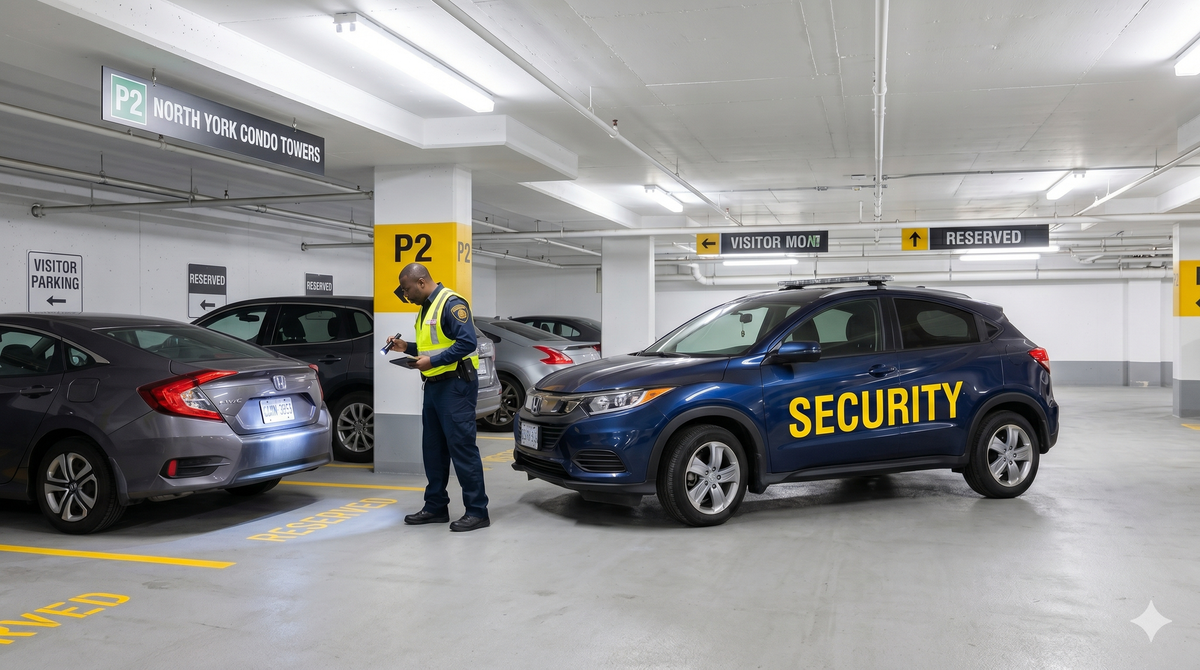
Condominium residents along the Yonge and Finch corridor in North York are waking up to smashed glass, missing catalytic converters, and empty parking spaces at an alarming rate. Securing a multi-level subterranean parking structure beneath a high-density residential tower presents a unique set of logistical challenges that cannot be solved by simply installing brighter lightbulbs or pointing a static camera at the entrance. These massive underground networks provide organized theft rings with exactly what they need to operate: complete concealment from public view, predictable resident commuting patterns, and multiple structural blind spots that degrade cellular communication.
Property managers and condo boards are under immense pressure to stop the financial bleeding and protect resident assets. Relying on passive security measures, such as unmonitored closed-circuit television (CCTV) cameras or signs threatening to tow unauthorized vehicles, simply provides a historical record of property loss rather than active deterrence. To establish a secure perimeter, boards must integrate physical human presence, tactical deployment strategies, and strict access control enforcement. Understanding the baseline for these operations is critical; reviewing the Condominium Concierge Security Management: The GTA Board Guide provides property managers with the foundational architecture needed to overhaul failing building policies.
The local operational reality in North York—particularly for older buildings near the Sheppard Avenue and Don Mills intersections—is that structural vulnerabilities are actively being exploited. Criminals are highly organized, arriving in stolen vehicles to scout the layout, identify high-value targets, and exploit tailgating opportunities to bypass overhead gates. Stopping them requires more than a desk concierge; it requires specialized, mobile enforcement that intercepts threats before a vehicle's window is ever shattered.
The Mechanics of Underground Vehicle Targeting
Organized theft syndicates targeting North York properties do not operate randomly. They utilize sophisticated scouting techniques to identify buildings with weak access controls. The most common point of failure is the primary overhead garage door. Thieves will park adjacent to the building ramp, wait for an authorized resident to swipe their key fob, and rapidly accelerate down the ramp, sliding under the gate before the timer cycles the door shut.
Once inside, the network operates with near impunity. The concrete walls of a P3 or P4 parking level naturally block cellular signals and VHF radio frequencies, isolating the thieves from external disruption. They use battery-powered angle grinders to sever catalytic converters in less than sixty seconds or deploy electronic relay devices to clone the signal of a luxury SUV's keyless entry system, driving the vehicle out of the garage without ever triggering an alarm.
The Consensus Verdict: Field data consistently reveals that unmonitored underground garage gates result in a 70% higher rate of targeted vehicle extraction than entryways monitored by a physical guard. Property boards must deploy a dedicated tactical guard to physically audit access points during peak commuting hours and immediately eliminate lengthy gate-closure timers that facilitate tailgating.
Deploying Tactical Roving Patrols
To counter these rapid-extraction methods, security providers must deploy tactical roving patrols. A guard sitting at the front lobby desk cannot protect a vehicle parked three levels underground. Roving patrols involve guards physically sweeping the garage footprint, but standard, predictable walking routes are completely ineffective. If a thief knows the guard walks through level P2 every hour on the hour, they simply wait for the guard to pass before executing the break-in.
Effective protection requires a randomized patrol matrix. Guards must alter their entry points, use different stairwells to transition between levels, and vary their dwell times within the garage. This unpredictability eliminates the criminal's ability to calculate a safe window of opportunity. When evaluating security strategies for large subterranean spaces, examining the cross-regional tactics detailed in Upgrading High-Rise Parking Garage Patrols in Mississauga illustrates exactly how fluid routing prevents organized scouting.
Estimated North York Garage Guard Coverage Tiers in CAD
| Guard Classification | Subterranean Deployment Focus | Estimated Hourly Bill Rate (CAD) | Risk Mitigation Target |
| Static Access Guard | Ramp monitoring, tailgating interception, visitor log verification | $24.00 - $28.00 | Gate breaches, unverified vehicle entry |
| Tactical Roving Guard | Randomized foot sweeps, stairwell clearing, door auditing | $27.00 - $33.00 | Smash-and-grabs, catalytic converter theft |
| Mobile Patrol Vehicle | Exterior perimeter illumination, rapid response drop-bys | $32.00 - $38.00 | Organized scouting networks outside the gate |
The Direct Link Between Garage Security and Liability
Beyond the devastating personal loss of a stolen vehicle, rampant garage break-ins severely impact the condominium corporation's commercial liability. If a resident's vehicle is burglarized and the investigation reveals that the garage gate was malfunctioning for a week without being logged, or that a security door was propped open with a brick, the board faces massive legal exposure for failing to maintain a secure environment.
Professional security guards serve as active risk documentarians. During their randomized patrols, they do more than look for thieves; they audit the structural integrity of the property. If a guard identifies a burned-out fluorescent fixture creating a dark blind spot, or a damaged crash bar on a fire exit door, they document the hazard immediately in a digital reporting system. This meticulous documentation forms the ultimate legal shield. For a deeper understanding of how these logs protect the corporation's financial health, How to Reduce Condo Liability with Trained Security Guards in North York breaks down the legal importance of incident reporting and active hazard mitigation.
Advanced Physical Security and Perimeter Hardening for North York Garages
Protecting thousands of vehicles across multi-phase condominium complexes requires a highly aggressive, deeply technical approach to physical perimeter hardening. The "Deep Dive" strategies outlined below target the zero-competition operational gaps that organized theft rings exploit daily. By implementing these advanced security protocols, property managers can effectively cut off the logistical pathways used by criminals, rendering the parking structure impenetrable.
Intercepting Tailgating at the Main Overhead Door
The overhead door is the most critical chokepoint of any North York high-rise. Tailgating is the primary vector for unauthorized entry because residents naturally assume the vehicle behind them belongs to a neighbor. To stop this, the security posture must become confrontational at the perimeter.
During the highest risk windows—typically the morning rush hour and the late-night return periods—a dedicated tactical guard must be positioned at the base of the ramp. This guard physically verifies that every single entering vehicle presents an authorized fob or is registered in the digital visitor log. If a tailgater attempts to follow a resident inside, the guard steps in, halts the vehicle, and forces the driver to reverse out of the structure. This highly visible enforcement signals to scouting networks that the building is not a soft target. Furthermore, the property manager must hire technicians to shorten the overhead door's dwell timer to the absolute minimum safe interval, forcing the door to close immediately after the authorized vehicle's rear bumper clears the threshold.
Combating Fob Cloning and Relay Attacks
Modern high-end vehicles, particularly those parked in luxury North York developments, are frequently stolen using relay attacks. Thieves stand near the resident's unit door in the hallway with a signal amplifier, capture the key fob's wireless frequency, and bounce it down to an accomplice standing next to the vehicle in the garage. The car unlocks and starts seamlessly.
While security guards cannot physically block a radio frequency, they can intercept the individuals executing the attack. Relay attacks require multiple people loitering in residential hallways and parking levels simultaneously. By deploying tactical guards to sweep the residential corridors and cross-reference loitering individuals with the active resident ledger, the security team breaks the physical chain required to execute the theft. If an unrecognized individual is found scanning doors on the 12th floor, they are immediately escorted off the property and handed over to the Toronto Police Service.
Lighting, Blind Spots, and Environmental Design
Criminals intentionally seek out dark zones within the garage footprint to conceal their activities while they utilize power tools. A massive, multi-level garage will inevitably have failed light fixtures, specifically in corners or deep within visitor parking sections.
Guards must conduct mandatory environmental audits during their rotations. Every single dark zone must be logged. Beyond simply reporting a broken bulb, security consultants should advise the board to invest in motion-activated LED flooding systems. When a thief walks into a previously dim corner, the area should instantly illuminate with industrial-grade lighting, destroying their concealment and triggering their psychological flight response. The guard's digital logs of these lighting audits also prove to insurance adjusters that the building is actively maintaining its environmental safety standards, directly shielding the board from negligence claims if an incident occurs.
The Legal Framework for Confronting Trespassers
Property managers often fear the liability of their security team physically engaging with criminals. In Ontario, under the Trespass to Property Act, a licensed security guard acting as an authorized agent of the condo board has the legal authority to direct any unauthorized individual to leave the premises immediately.
When a guard encounters individuals attempting a smash-and-grab in the P3 level, their training dictates a structured escalation of force. The primary objective is deterrence. The guard will utilize their high-intensity tactical flashlight, announce their presence loudly, and immediately dispatch a call to the Toronto Police Service via a hardwired emergency landline or localized Wi-Fi phone network. Thieves prioritize easy extractions; the moment a uniformed guard interrupts their operation and illuminates their position, they will abandon the target and flee. The guard does not need to physically tackle the suspect; destroying the thief's operational secrecy is the most effective defense.
Securing Resident Storage Lockers Adjacent to Parking
In many North York condominiums, residential storage lockers are housed in chain-link enclosures directly adjacent to the parking stalls. Thieves who gain access to the garage will frequently pivot from targeting cars to cutting the padlocks off these lockers, extracting bicycles, seasonal tires, and expensive tools. Because residents rarely visit their lockers daily, these thefts can go unnoticed for weeks.
To harden this secondary target, guards must incorporate physical padlock checks into their subterranean sweeps. They must physically rattle the gates and inspect the chain-link perimeters for fresh cuts or manipulated wiring. If a guard discovers a breached locker during a 3:00 AM patrol, they secure the area, document the specific unit number, and notify the property manager before morning. This immediate detection prevents the thief from returning the following night to empty adjacent lockers.
Managing Visitor Parking Abuse
Visitor parking spaces in densely populated transit corridors are constantly abused by non-residents looking for free parking near subway stations. This introduces unknown, unvetted vehicles into the secured subterranean footprint of the building.
The security team must manage a strict digital permit system. When a guard patrols the visitor section, they cross-reference the license plates of parked vehicles with the active digital visitor log managed at the concierge desk. If a vehicle does not have a valid, active permit, the guard immediately issues a municipal parking infraction and coordinates with an authorized towing vendor to remove the vehicle. Removing unvetted vehicles eliminates the possibility that a theft crew is using a "stashed" car inside the visitor lot as a staging ground for a larger heist.
Implementing Unpredictable Patrol Matrices
The ultimate weapon against organized garage theft is unpredictability. If a security provider utilizes an automated checkpoint tour system that requires a guard to scan a barcode on the P1 level every sixty minutes, the security system is actively aiding the criminals by providing a reliable schedule of absence.
Security directors must design fluid routing matrices. A guard might sweep P1, skip to P3, use the East stairwell to return to the lobby, and then immediately drop back down to P2. Furthermore, guards must incorporate "tactical pauses," standing silently in elevator vestibules or behind structural pillars for several minutes, simply listening for the acoustic signatures of breaking glass or grinding metal echoing through the concrete. This fluid, unpredictable presence makes the entire subterranean structure hostile territory for any criminal operation.
If your North York property requires immediate intervention to stop escalating underground vehicle thefts and secure your multi-level parking perimeter, request a custom security quote from Maximum PI Security to deploy a dedicated tactical guard force today.

Frequently Asked Questions
A licensed condominium security guard effectively stops underground parking garage break-ins by executing randomized multi-level tactical patrols, enforcing strict anti-tailgating protocols at the main overhead gate, and managing digital visitor parking logs to remove unvetted vehicles. Operating under the Ontario Trespass to Property Act, these highly visible, unpredictable physical sweeps destroy the concealment required by organized auto-theft rings, forcing criminals to abandon the property.
What should a security guard do if they catch someone breaking into a car?
When a licensed security guard intercepts an active vehicle break-in within an underground garage, their protocol is to observe, deter, and report. They will use high-intensity tactical lighting and verbal commands to destroy the criminal's concealment, prompting them to flee. Simultaneously, the guard immediately contacts the Toronto Police Service and secures the perimeter to preserve forensic evidence, prioritizing personal safety and de-escalation over physical detention.
Can condo boards be sued if a car is stolen from the underground parking lot?
Yes, condominium corporations can face significant civil liability if a resident's vehicle is stolen and the board is found negligent in maintaining basic security standards. If access gates were left broken for extended periods, security patrols were improperly managed, or structural blind spots were ignored, the board may be held financially responsible for failing to provide a reasonably safe environment.
How do security guards handle cellular dead zones in deep parking levels?
Professional security teams overcome subterranean communication dead zones by utilizing hardwired emergency landlines positioned throughout the lower levels or by connecting to localized Wi-Fi calling networks installed by the property management. Guards also operate under strict "deadman" interval check-ins; if a guard fails to report to the front desk within a specific timeframe while patrolling a deep level, emergency protocols are automatically triggered.
About the Author
Jeff Calixte is an online exclusive content sell strategist with a deep background in tracking local asset protection data, analyzing Southern Ontario labor rates, and outlining real operational deployment structures across the Greater Toronto Area.
Sources
- Ontario Trespass to Property Act Regulations
- Toronto Police Service - Auto Theft Prevention Guidelines
Note
Commercial bill rates, guard wages, deployment conditions, and vendor availability can vary widely by province, municipality, season, and project scope. All pricing estimates, labor figures, and career examples in this guide are approximations based on current Ontario market data. Always confirm contract details, licensing compliance, and specific rate quotes directly with your chosen service provider or employer before finalizing any agreements.