Event Security Guard Requirements in Downtown Toronto
Corporate party planners face strict municipal compliance and liability risks when hosting events in the downtown core. Discover the legal guard requirements, AGCO liquor enforcement protocols, and access control strategies required to secure your private event safely.
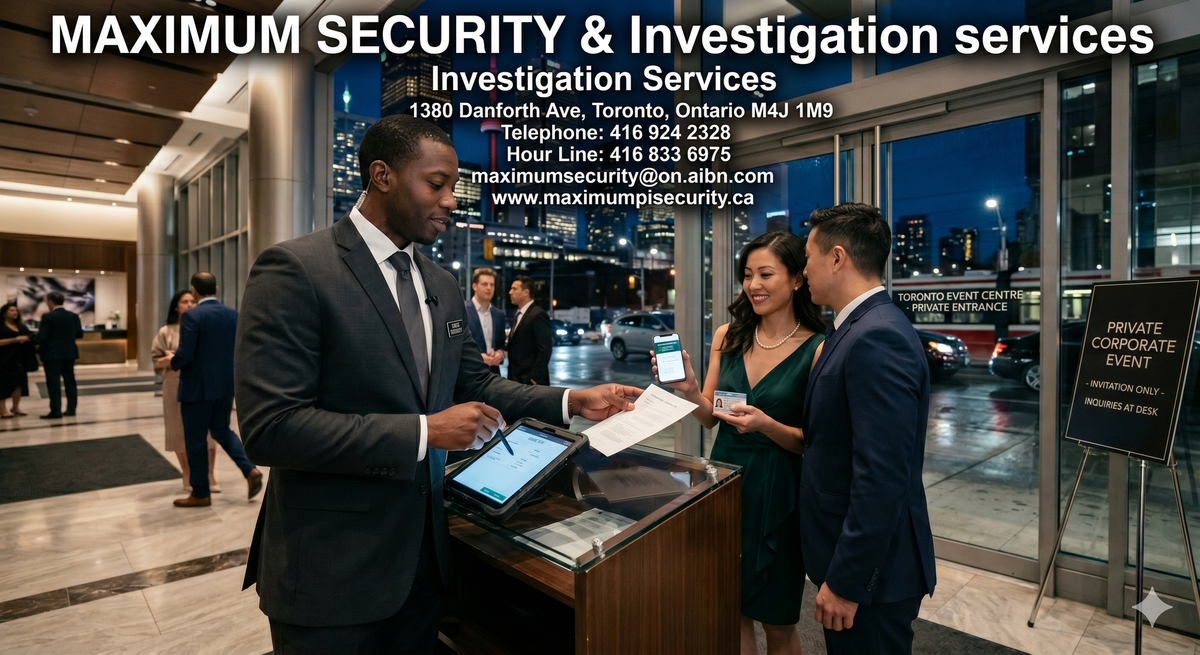
Hosting a massive private gathering in the heart of Downtown Toronto—whether it is a corporate holiday party in the Entertainment District, a high-profile brand activation along King Street West, or an exclusive rooftop gala near the Financial District—instantly transfers severe municipal and legal liabilities onto the event planner. Relying on standard venue ushers or uncertified administrative staff to manage guest verification, intercept aggressive gate-crashers, and handle intoxicated attendees creates an unacceptable operational risk profile. When event planners fail to deploy professionally licensed security personnel, they expose their clients to immediate event shutdowns by the Toronto Police Service (TPS), devastating fines from the Alcohol and Gaming Commission of Ontario (AGCO), and massive civil lawsuits if a critical safety incident occurs on the premises.
The local reality of organizing events within Toronto’s dense urban core is that private venues are highly vulnerable to unauthorized access. Pedestrian traffic along major corridors like Queen Street West and Spadina Avenue guarantees that opportunistic individuals will notice a high-end gathering and attempt to bypass the front doors. If an uninvited individual slips past an unmonitored checkpoint, they compromise the safety of the registered guests and present a direct threat to the event’s liquor license. To establish a secure environment, organizers must understand the exact provincial standards governing crowd management and access control. For a comprehensive look at staging safe urban operations, reviewing How to Plan Special Event Security for GTA Venues provides event directors with the foundational blueprint necessary to satisfy municipal regulators and protect their corporate clients.
Securing a downtown venue requires a deeply structured security matrix. Planners must enforce strict perimeter choke points, execute rapid identification verification, and maintain a constant, low-profile physical presence capable of de-escalating conflicts without disrupting the celebratory atmosphere. Without these defensive layers in place, a private corporate function can rapidly devolve into a logistical nightmare, jeopardizing the organizing agency's reputation and future municipal permitting capabilities.
The Consensus Verdict on Event Access Control
Field data consistently reveals that private events utilizing a decentralized entry strategy without dedicated guest list verification experience a 55% higher rate of unauthorized entry and subsequent alcohol-related infractions. Corporate planners must mandate the deployment of a single, hyper-structured main access choke point managed by licensed concierge guards, and strictly avoid spreading security resources across multiple porous entry doors.
Understanding AGCO Compliance and Liquor Liability
The most significant financial and legal vulnerability for any private event planner in Ontario is the service of alcohol under a Special Occasion Permit (SOP). The AGCO operates with absolute zero tolerance for infractions during private functions. If an underage individual is found consuming alcohol, or if a noticeably intoxicated patron is over-served and subsequently causes property damage, the permit holder, the venue operator, and the event planner share the legal liability.
Standard wristbands are completely insufficient to deter organized underage drinking or unauthorized consumption. Professional security deployments execute a highly mobile secondary ID check protocol. Guards actively patrol the bar area and the main floor, monitoring consumption rates and intercepting visibly intoxicated guests before they reach the bartender. This aggressive, proactive enforcement protects the event's liquor license and prevents alcohol-fueled disruptions from ruining a high-profile corporate function.
Estimated Downtown Toronto Event Guard Coverage Tiers in CAD
| Security Function | Operational Deployment Focus | Estimated Hourly Bill Rate (CAD) | Primary Liability Target |
| Access Control Concierge | Guest list validation, digital check-in, coat check monitoring | $26.00 - $32.00 | Gate crashers, unverified attendees |
| AGCO Enforcement Guard | Bar line monitoring, intoxication intercepts, age verification | $28.00 - $34.00 | Liquor license infractions, over-serving |
| Tactical Crowd Manager | Floor sweeps, washroom checks, physical de-escalation | $30.00 - $36.00 | Harassment, physical altercations |
Preventing Perimeter Breaches and Tailgating
Downtown Toronto venues frequently utilize secondary service doors, rear loading docks, and interconnected emergency stairwells. While the main entrance might be secure, third-party vendors, catering staff, and audio-visual technicians often prop open these rear access points to transport heavy equipment. This creates a massive security void, allowing unvetted individuals from the public street to walk directly into the private event space unchallenged.
To lock down the logistics chain, the security team must treat all third-party vendors as potential access vulnerabilities. Planners must provide the security supervisor with a complete manifest of authorized vendor companies. When a catering truck arrives, a guard verifies the driver's company identification and ensures they are only accessing the designated staging areas. Security personnel must actively monitor the service doors during the entire event, ensuring no access point is left permanently propped open. This strict enforcement of access parameters mirrors the operational rigidity required to secure residential lobbies, an approach thoroughly detailed in our analysis of Downtown Toronto Condo Security: Managing Visitor Access Control Safely.
Deep Dive: Advanced Threat Mitigation, Hostile Vehicle Interception, and Medical Egress
Protecting a high-capacity private event in a dense urban environment requires far more than stationing a guard with a clipboard at the front door. Sophisticated threats, ranging from organized counterfeit credential rings to severe medical emergencies, demand a highly technical, aggressive approach to operational planning. This section explores the deeply specialized, zero-competition strategies that professional security directors use to harden downtown venues, ensure absolute regulatory compliance, and execute seamless crisis management under extreme pressure.
Intercepting Corporate Espionage and Counterfeit Invitations
When high-profile technology firms or financial institutions host private gatherings in Toronto, corporate espionage becomes a legitimate operational threat. Competitors frequently attempt to infiltrate these events to gather intelligence on upcoming product launches, poach top-tier executive talent, or capture unauthorized photographs of proprietary presentations. These infiltrators do not simply jump the fence; they arrive wearing expensive suits, carrying highly convincing counterfeit invitations or media credentials.
To stop this, the access control team must utilize advanced digital credentialing software. A standard printed list is entirely useless against a sophisticated infiltrator. Professional guards scan unique, encrypted QR codes sent directly to the authorized guest's verified corporate email address. Furthermore, the security team must physically cross-reference the digital pass with government-issued photo identification or a verified corporate badge to confirm that the individual holding the pass is the specific person who was invited. If an anomaly is detected, the individual is quietly escorted to a separate resolution desk away from the main entrance, preventing them from causing a public scene. This strict credentialing process is exactly what makes elite event operations successful, as seen in the protocols for Licensed Security Guards for Corporate Product Launches in Markham.
Managing Hostile Vehicle Mitigation (HVM) in the Downtown Core
Events hosted at ground-level venues facing major arterial roads—such as spaces along Front Street or Richmond Street—are highly vulnerable to vehicular incursions. In the modern security landscape, the threat of a hostile vehicle intentionally or accidentally breaching a dense pedestrian queue waiting outside a venue is a primary concern.
Standard orange traffic cones or velvet ropes provide absolutely zero physical stopping power. If a queue extends onto the municipal sidewalk, professional event security requires the deployment of engineered Hostile Vehicle Mitigation (HVM) assets. Planners must work with the municipality to position heavy water-filled jersey barriers or engineered mobile crash barricades to shield the pedestrian line from live traffic lanes. Guards stationed outside the venue focus entirely on external threat monitoring, ensuring the physical perimeter holds against potential vehicular impact while the interior team manages guest processing.
Tactical De-escalation and Soft Extractions
Private corporate events are high-stakes environments where networking and alcohol flow freely. When a high-ranking executive or an invited VIP becomes highly intoxicated and combative, standard security protocols must be rapidly adjusted. Physically tackling a corporate VP is completely unacceptable and will result in catastrophic reputational damage for the organizing agency, but allowing them to assault another guest or verbally abuse the waitstaff is equally disastrous.
Security personnel deployed to corporate events must possess advanced verbal de-escalation training. When an incident occurs, guards utilize a "soft extraction" technique. Two guards approach the individual, smoothly step between them and the conflict point to break physical contact, and isolate the primary aggressor by walking them toward a quieter, private area. The primary goal is to lower the emotional temperature and convince the individual that it is their own idea to leave the event. The security supervisor then quietly coordinates with the event planner or a sober colleague to arrange a private executive car service, ensuring the individual is escorted off the property safely and discreetly.
Engineering Medical Emergency Extraction Corridors
When a medical emergency occurs deep within a packed venue—such as a guest suffering a cardiac event on the dance floor or experiencing severe an anaphylactic shock from catering—Toronto Paramedic Services cannot physically push a stretcher through a crowd of six hundred people. If the medical response is delayed by a congested floor plan, the outcome can quickly become fatal.
Security directors must engineer dedicated medical extraction corridors into the venue layout before the first guest arrives. These are physically cleared, sterile lanes that run from the deepest parts of the crowd directly to the emergency exit doors and ambulance staging bays. When an incident occurs, the crowd management guards instantly locate the victim, form a protective physical ring around them to keep panicked guests back, and clear the sterile lane. When paramedics arrive, the security team escorts them directly to the patient without impedance, ensuring rapid, life-saving medical intervention.
Controlling Coat Check and High-Value Asset Theft
At high-end winter events in Toronto, the coat check becomes a massive repository of luxury assets, including expensive outerwear, designer bags, and corporate briefcases containing sensitive laptops. Thieves specifically target poorly managed coat check areas, using stolen claim tickets or exploiting distracted attendants to extract thousands of dollars in stolen property.
Event security teams must assert physical control over the coat check perimeter. A dedicated guard must be stationed directly at the coat check counter during peak arrival and departure windows. This guard enforces an unbroken chain of custody, ensuring that no individual is permitted behind the counter under any circumstances, and that attendants are strictly verifying claim tickets before releasing any item. By maintaining a constant visual deterrent, the security team completely eliminates the opportunity for opportunistic asset theft. This focus on internal asset protection is a critical element of managing high-value environments, a strategy also applied to Visible Uniformed Deterrents for High-Shrinkage Stores in Downtown Toronto.
Securing the Teardown Phase and Post-Event Sterile Sweeps
The most vulnerable phase of a private downtown event occurs after the final guest has left. The "teardown" phase is highly chaotic; audio-visual crews are dismantling expensive staging, caterers are moving heavy equipment, and the organizing staff is exhausted. This is the exact moment when a corporate laptop goes missing, or individuals who were previously ejected attempt to sneak back inside to steal leftover alcohol or equipment.
The security team's mandate does not end when the music stops. Guards must lock down the venue perimeter, ensuring that only authorized third-party vendors with verified teardown credentials are permitted back inside the building. Furthermore, guards must conduct a complete sterile sweep of the venue, checking washrooms, behind stages, and in private green rooms to ensure no sensitive corporate data, mobile phones, or branded materials have been accidentally left behind. Only after the venue is completely cleared and secured does the security supervisor sign off and hand control back to the property management.
If your agency is planning a massive corporate gala, a private brand activation, or an exclusive high-capacity gathering in Downtown Toronto, request a custom security quote from Maximum PI Security to deploy a highly trained, fully licensed event security team and ensure your event runs flawlessly and in full municipal compliance.
Frequently Asked Questions
Do I legally need to hire security guards for a private party in Toronto?
Yes, if you are obtaining a Special Occasion Permit (SOP) from the AGCO to serve alcohol at a rented venue, the AGCO and the local fire marshal frequently mandate a specific ratio of licensed security guards based on the venue's capacity. Additionally, virtually all commercial event spaces and corporate venues in Downtown Toronto require the organizer to provide proof of third-party licensed security as a mandatory condition of the rental contract to protect the property's insurance liability.
Can event security guards physically remove a guest from a private corporate party?
Absolutely. When an event planner rents a private venue, they become the legal occupier of that space for the duration of the contract. Under the Ontario Trespass to Property Act, the occupier has the absolute right to determine who is permitted on the premises. The licensed security guards act as authorized agents; if an uninvited or disruptive guest refuses to leave when directed, the guard possesses the legal authority to escort them off the property or contact the Toronto Police Service to execute a formal trespass arrest.
How do security guards stop people from sneaking into private events?
Professional event security teams stop unauthorized entry by enforcing a strict, single-point access choke point utilizing digital QR code scanning and government ID cross-referencing. They completely eliminate secondary access vulnerabilities by physically locking down and monitoring rear service doors, kitchen entrances, and loading docks. By establishing a hard perimeter and actively deterring tailgating at the main doors, guards ensure only verified guests gain access to the private space.
A licensed event security guard ensures the safety of private functions in Downtown Toronto by executing strict digital guest list verification to stop corporate espionage, aggressively enforcing AGCO liquor laws to prevent over-serving, and maintaining sterile emergency egress corridors for rapid medical response. Operating under the Ontario Trespass to Property Act, these professional teams provide the tactical crowd management required to de-escalate conflicts, secure high-value assets, and protect corporate event planners from catastrophic legal liability.
About the Author
Jeff Calixte is an online exclusive content sell strategist with a deep background in tracking local asset protection data, analyzing Southern Ontario labor rates, and outlining real operational deployment structures across the Greater Toronto Area.
Sources
- Alcohol and Gaming Commission of Ontario (AGCO) - Special Occasion Permits
- Toronto Police Service - Special Events and Paid Duty Guidelines
- Ontario Trespass to Property Act, R.S.O. 1990
Note
Commercial bill rates, guard wages, deployment conditions, and vendor availability can vary widely by province, municipality, season, and project scope. All pricing estimates, labor figures, and career examples in this guide are approximations based on current Ontario market data. Always confirm contract details, licensing compliance, and specific rate quotes directly with your chosen service provider or employer before finalizing any agreements.