Preventing Front Desk Parcel Theft in Downtown Toronto High-Rises
The massive surge in app-based deliveries has turned Downtown Toronto condominium lobbies into unmanageable package depots. Discover the strict concierge logging protocols, access control strategies, and physical security measures required to stop front desk parcel theft.
Luxury condominium lobbies across Downtown Toronto—specifically along the dense vertical corridors of CityPlace, the Entertainment District, and the Bay Street financial perimeter—are buckling under the sheer volume of daily e-commerce deliveries. High-rise properties that were architecturally designed twenty years ago to handle a few letters and the occasional floral arrangement are now processing hundreds of packages daily from Amazon, UPS, and localized food couriers. When an unmanaged lobby reaches capacity, couriers simply abandon packages in public vestibules or pile them on unattended concierge desks, creating an immediate, high-value target for opportunistic theft.
Property managers and condominium boards face a severe logistical and liability crisis. When a resident's expensive electronics or time-sensitive medical deliveries disappear from the front desk, the immediate assumption is that building security failed. Relying on passive measures, such as pointing a low-resolution camera at a pile of cardboard boxes, provides absolutely no deterrent against organized parcel theft. Overhauling this logistical nightmare requires implementing strict, physically enforced courier protocols and deploying trained personnel capable of managing high-volume asset tracking. Establishing a baseline for these operations is critical; consulting the Condominium Concierge Security Management: The GTA Board Guide provides condo boards with the foundational architecture necessary to restructure their entire lobby workflow.
The local reality in the urban core is that parcel theft is no longer a crime of opportunity; it is an organized operation. Individuals exploit busy commuter windows, tailgating behind residents to gain access to the lobby. Once inside, they blend in with the transient flow of short-term renters and food couriers, sweeping unsecured packages into large bags and exiting before the lone concierge even notices the discrepancy. Stopping this massive inventory shrinkage requires shifting the security posture from passive observation to active, militant logistics control.
The Chaos of Unmanaged Delivery Traffic
The fundamental vulnerability in Downtown Toronto properties is the unrestricted movement of delivery personnel. Couriers operate under extreme corporate time constraints. If a concierge is occupied dealing with a resident dispute or conducting a floor patrol, the courier will not wait. They will dump the packages in the nearest accessible corner and leave. This creates a chaotic staging ground where residents, authorized guests, and potential thieves all have physical access to unverified parcels.
Compounding the issue is the lack of strict access control integration. In buildings without a dedicated parcel room, packages are often stored in plain sight behind the front desk. When a thief observes a high-value retailer logo on a box from the public vestibule, they simply wait for the concierge to look away or step into the back office before reaching over the counter. Integrating structural logistics with physical guarding, as explored in our recent breakdown of Downtown Toronto Condo Security: Managing Visitor Access Control Safely, is the only effective method of compartmentalizing external threats from internal residential assets.
The Consensus Verdict: Field data consistently reveals that high-rise properties utilizing manual, paper-based package logs suffer a 60% higher rate of parcel theft and misplacement than buildings employing digital barcode-scanning software. Property boards must mandate the deployment of cloud-based package logging systems and strictly avoid any security provider relying on handwritten sign-out sheets to track resident assets.
Enforcing Choke Points and Physical Verification
To secure the lobby environment, the security concierge must operate as an uncompromising logistical choke point. The board must establish a rigid "lobby-only" delivery mandate within the building bylaws. Couriers must be legally prevented from taking packages directly to residential unit doors. Unescorted couriers wandering residential hallways provide massive security gaps, allowing them to scout units, prop open fire doors, or steal packages left by other delivery services.
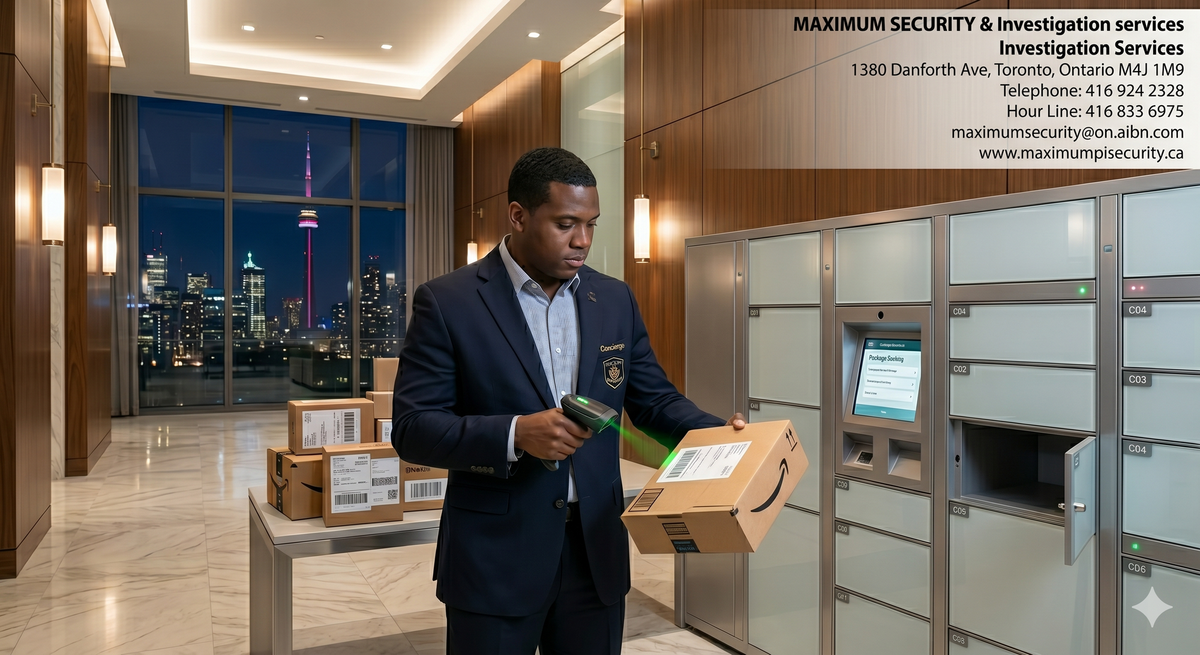
When a courier arrives, the concierge must take immediate physical custody of the item. The package is scanned into the property management database, which instantly sends an automated text message or email notification to the resident. The package is then immediately locked in a secured, camera-monitored parcel room. When the resident arrives to claim the item, the concierge demands physical, government-issued identification or verifies the resident's specific fob sequence before releasing the asset. This unbroken chain of custody eliminates the "porch pirate" vulnerability entirely.
Estimated Downtown Concierge Parcel Management Tiers in CAD
| Security Function | Operational Deployment Focus | Estimated Hourly Bill Rate (CAD) | Shrinkage Mitigation Target |
| Basic Desk Concierge | Manual logging, visual observation, lobby sign-in | $24.00 - $28.00 | Casual misplacement, courier dumping |
| Logistics Security Specialist | Digital barcode scanning, ID verification, parcel room control | $28.00 - $32.00 | Organized lobby theft, false resident claims |
| Tactical Roving Guard | Vestibule sweeping, tailgating interception, courier enforcement | $30.00 - $35.00 | Physical perimeter breaches, unverified hallway roaming |
Managing False Claims and Liability Exposure
Parcel theft is not always an external threat; internal liability is a massive issue for Downtown Toronto condo boards. A common scenario involves a resident claiming a high-value package was delivered by the courier but never received from the concierge. Without a rigorous, digitally time-stamped logging system, the condominium corporation is entirely exposed to civil claims and demands for financial reimbursement.
A trained security guard utilizing digital scanning software provides an impenetrable legal defense. If a resident claims their package was stolen, the property manager can instantly pull the digital log showing exactly what time the courier surrendered the item to the guard, the exact time the package was placed in the secure room, and the digital signature of the resident who picked it up. By maintaining this continuous digital ledger, boards completely insulate themselves from fraudulent claims. For a deeper analysis on how precise documentation directly shields corporate budgets from escalating legal payouts, reviewing the cost-saving strategies in How to Reduce Condo Liability with Trained Security Guards in North York illustrates the financial necessity of trained oversight.
Deep Dive: Advanced Lobby Architecture, Automated Lockers, and Logistics Hardening
Protecting thousands of inbound parcels within the dense, high-traffic corridors of Downtown Toronto requires far more than placing a guard behind a desk. Organized theft networks specifically target buildings with poor architectural flow and outdated storage methods. This section explores the advanced technical integrations, physical environmental redesigns, and strict operational protocols required to harden condominium lobbies against sophisticated logistics theft.
Integrating Automated Smart Locker Systems
The most significant upgrade a condominium board can make to secure its package infrastructure is the installation of automated smart lockers. As delivery volumes continue to surge past the physical capacity of traditional concierge desks, guards are simply running out of square footage to safely store boxes. When overflow occurs, packages inevitably end up stacked in public hallways, immediately triggering property theft.
Smart locker systems fundamentally change the delivery dynamic. When a courier arrives, they bypass the concierge entirely for standard parcels. The courier enters a unique vendor pin into the locker's digital terminal, selects an appropriately sized compartment, and places the package inside. The heavy steel door locks automatically, and the system instantly texts the resident a one-time pick-up barcode.
The security guard's role shifts from a package handler to an access control enforcer. Because the guard is no longer distracted by scanning 200 individual Amazon boxes, they can maintain a constant, heads-up physical watch over the main entrance, intercepting tailgaters and monitoring suspicious activity. The lockers act as an impenetrable physical vault, eliminating the "smash-and-grab" vulnerability of open lobby shelving.
Combating "Inside Jobs" and False Identity Extraction
Organized parcel theft rings frequently deploy sophisticated social engineering tactics to extract high-value electronics from building security. A thief will retrieve a discarded shipping label or track a specific delivery notification, walk up to the concierge desk during a shift change, and confidently demand a package under a resident's name, claiming they left their ID in their unit.
Untrained or temporary concierge staff frequently succumb to this pressure to avoid conflict, handing over thousands of dollars in merchandise to a complete stranger. Professional security guards operate under absolute, zero-tolerance verification protocols. If a resident cannot produce government-issued identification matching the package label, or provide digital verification via the official property management application, the package is not released. Furthermore, guards are trained to identify counterfeit identification and log the interaction immediately if a suspect becomes combative. This rigid adherence to policy is the only way to stop identity-based extraction.
Securing the Oversized and High-Value Freight Perimeter
While smart lockers solve the volume issue for small parcels, Downtown properties frequently deal with oversized freight deliveries, such as custom furniture, large appliances, or bulk construction materials destined for unit renovations. Couriers attempting to deliver these massive items will often prop open exterior fire doors to maneuver hand trucks, destroying the building's physical perimeter security.
To manage heavy freight, the security team must enforce strict loading dock protocols. The board must mandate that all oversized deliveries be scheduled in advance through the property management office. When the freight truck arrives, a dedicated tactical guard meets the driver at the subterranean loading bay. The guard physically supervises the offloading process, escorts the delivery team via the designated padded service elevator, and ensures the exterior loading doors are locked immediately after the drop-off. By funneling high-risk freight through heavily monitored subterranean channels, the main lobby remains sterile and secure, a tactic deeply connected to the perimeter hardening strategies discussed in our analysis of Upgrading High-Rise Parking Garage Patrols in Mississauga.
Overcoming the Grocery and Food Delivery Bottleneck
The explosion of app-based food and grocery deliveries (UberEats, Instacart) presents a unique logistical threat. Unlike standard parcels, food deliveries cannot be locked in a parcel room or a smart locker due to spoilage risks. Couriers arrive continuously, especially between 6:00 PM and 9:00 PM, demanding immediate access to residential floors.
Condo boards must implement a strict "Lobby Hand-Off" policy for all perishable deliveries. The concierge intercepts the courier at the vestibule and directs them to a designated, camera-monitored staging table. The courier leaves the food, and the resident is entirely responsible for coming down to the lobby to retrieve it. The concierge does not accept custody, signature, or responsibility for food items. This policy completely prevents unvetted individuals from roaming residential hallways and stops residents from falsely claiming the guard "stole" their dinner.
Implementing Environmental Design and Traffic Flow Control
The physical layout of the lobby dictates the level of security control a guard can exert. Many Downtown Toronto buildings feature sprawling, open-concept lobbies where residents, guests, and couriers all funnel through a single set of doors and mingle in front of the elevators. This lack of physical compartmentalization makes it impossible to track who is picking up a package and who is attempting to bypass the desk.
Security consultants should advise boards on implementing basic Crime Prevention Through Environmental Design (CPTED) principles. This involves using physical stanchions, heavily weighted planters, or structural barriers to force all incoming traffic into a single-file line directly past the concierge desk. Couriers must be routed to a specific "Vendor Check-In" side of the desk, while residents are routed to a "Resident Verification" side. By forcing the physical traffic flow into organized, observable lines, the guard can easily isolate suspicious behavior and stop individuals attempting to slip past the logistics choke point.
Handling Unclaimed Packages and Fire Code Violations
A hidden liability of extreme parcel volume is the accumulation of unclaimed boxes. Residents who travel frequently for business often leave packages sitting in the condo parcel room for weeks. When the room reaches capacity, boxes spill out into the main lobby hallways, obstructing fire exits and directly violating Toronto Fire Services safety codes. If an emergency occurs and the evacuation route is blocked by a wall of Amazon boxes, the condo board faces massive municipal fines and extreme civil liability.
The security concierge must execute rigorous inventory management. Guards conduct weekly audits of the parcel room. If a package remains unclaimed past the board-mandated hold period (typically seven to fourteen days), the guard logs the infraction, contacts the courier service to execute a "Return to Sender" protocol, and physically removes the asset from the building. This active maintenance ensures the property remains compliant with provincial fire codes and prevents the lobby from becoming a localized warehouse.
If your Downtown Toronto property is drowning in unmanaged deliveries, facing daily resident complaints regarding lost packages, and experiencing severe logistics bottlenecks, request a custom security quote from Maximum PI Security to deploy a highly trained, digitally equipped concierge team today.

Frequently Asked Questions
A licensed condominium security concierge stops front desk parcel theft by enforcing strict logistical choke points, utilizing digital barcode tracking software to maintain an unbroken chain of custody, and mandating rigorous government ID verification before releasing any high-value asset. By isolating courier traffic to the main lobby and preventing unescorted deliveries to residential units, these physical security protocols eliminate the operational vulnerabilities exploited by organized theft rings in Downtown Toronto.
Can a Toronto condo security guard refuse to sign for a package?
Yes. If a package appears heavily damaged, leaking, or violates the condominium's size and weight restrictions outlined in the building bylaws, the licensed security guard is legally authorized and operationally required to refuse delivery. The courier must then return the item to their depot, protecting the condo board from liability regarding damaged or hazardous goods.
What should a resident do if their package is stolen from the condo lobby?
If a package is confirmed stolen from a condo lobby, the resident must immediately report the theft to the property manager and the security concierge. The security team will lock down the digital package logs and review the specific timestamped CCTV footage to identify the suspect. The resident must then file a formal property theft report with the Toronto Police Service, providing the security data as primary evidence.
Are condo boards legally liable for stolen packages left with the concierge?
Generally, condo boards are insulated from direct liability for stolen packages if they have implemented reasonable, documented security measures. However, if the board failed to provide a secure storage area, forced guards to rely on highly flawed manual paper logs, or ignored repeated instances of theft without upgrading their protocols, residents may successfully sue the corporation for gross negligence in maintaining building security.
About the Author
Jeff Calixte is an online exclusive content sell strategist with a deep background in tracking local asset protection data, analyzing Southern Ontario labor rates, and outlining real operational deployment structures across the Greater Toronto Area.
Sources
- Toronto Police Service - Property Crime and Theft Prevention
- Condominium Authority of Ontario - Security and Property Management Guidelines
Note
Commercial bill rates, guard wages, deployment conditions, and vendor availability can vary widely by province, municipality, season, and project scope. All pricing estimates, labor figures, and career examples in this guide are approximations based on current Ontario market data. Always confirm contract details, licensing compliance, and specific rate quotes directly with your chosen service provider or employer before finalizing any agreements.