Lock-up and Unlock Mobile Security Patrols on Danforth Ave
Local restaurants, bars, and retail shops along Danforth Avenue face severe after-hours vulnerabilities. Discover how commercial lock-up and unlock mobile security patrols eliminate staff risk and protect your East York business.
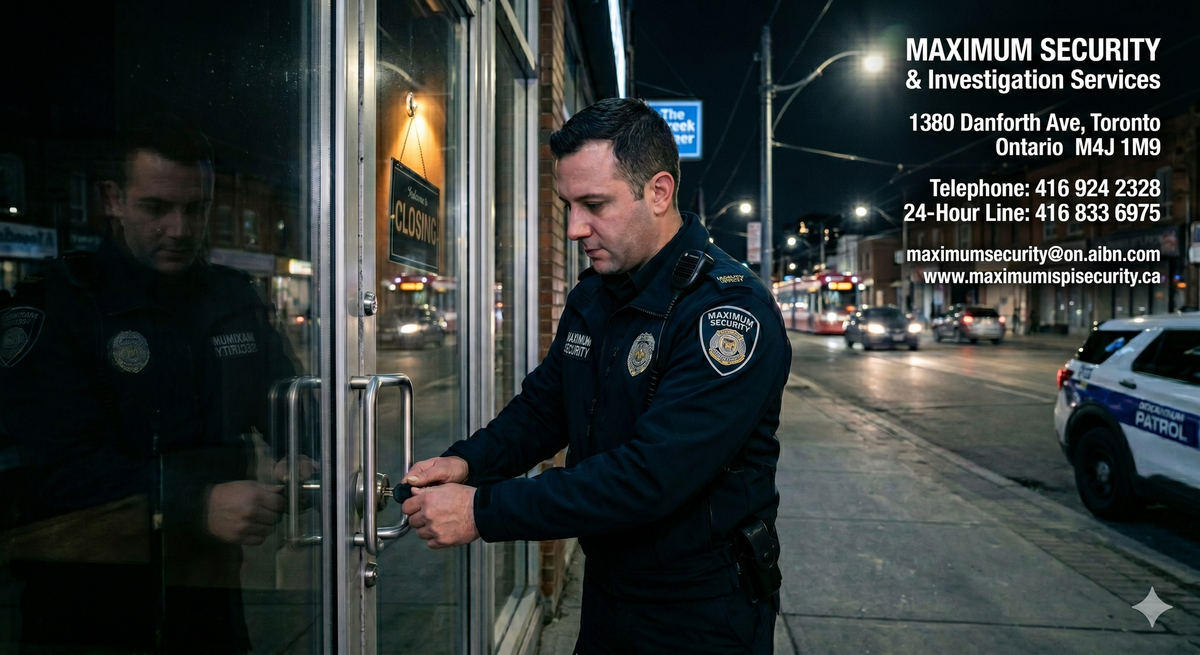
Operating a bustling restaurant, late-night bar, or independent retail shop along the vibrant Danforth Avenue corridor—stretching from the busy intersections of Broadview and Pape all the way east to Coxwell and Woodbine—is a high-energy endeavor. The Danforth is famous for its dense foot traffic, late-night dining scene, and tight-knit community. However, the operational reality of managing a storefront in this heavily trafficked urban environment means dealing with significant security vulnerabilities at the very beginning and the absolute end of the business day.
For local business owners, the "lock-up" and "unlock" procedures represent the highest-risk moments for their front-line staff and their commercial assets. Forcing a young shift supervisor or an exhausted restaurant manager to handle cash register reconciliations, lock the rear laneway doors, and walk to their car alone at 3:00 AM introduces massive physical risks and corporate liability. Conversely, the first barista or retail clerk arriving at 5:30 AM frequently faces the dangerous task of clearing individuals sleeping in recessed doorways or potentially walking into an active, undiscovered overnight break-in.
To eliminate these dangerous operational gaps, proactive East York business owners are removing the burden from their internal staff entirely. Deploying a professional mobile security patrol to execute dedicated, verified lock-up and unlock procedures ensures that your business is impenetrable overnight, your staff remain completely safe, and your daily operations begin and end without incident.
The Operational Threat of Opening and Closing Procedures
The vulnerability of opening and closing a commercial storefront on the Danforth stems from the combination of high-value assets (cash and easily liquidated inventory) and low staff visibility. Criminals actively observe the operational rhythms of local businesses. They know exactly when the main dining room clears out, when the rear kitchen staff leaves, and when the lone manager is left balancing the night's receipts.
Consensus Analysis: Employee Keyholders vs. Professional Guard Lock-Ups
When structuring their daily operational workflows, business owners frequently debate whether to issue master keys and alarm codes to their shift supervisors or to outsource the responsibility to a specialized mobile patrol service.
The Verdict:
- Avoid This: Designating a 20-year-old retail cashier or restaurant server as the primary keyholder responsible for locking down the premises, setting the main alarm, and clearing the property late at night. Internal staff lack the tactical training required to handle an aggressive loiterer or a sudden robbery attempt. Furthermore, if an employee forgets to set the alarm or fails to properly lock the rear shipping door, the business owner absorbs 100% of the resulting theft loss, as commercial insurance carriers will deny claims caused by internal negligence.
- Buy This: Contract a licensed mobile security patrol service to execute a formal lock-up and unlock protocol. A professional patrol officer arrives precisely at closing time, conducts a thorough interior sweep to ensure no patrons are hiding in the washrooms, arms the central alarm panel, and physically locks all exterior doors. In the morning, they reverse the process, ensuring the storefront is completely safe and ready for your staff to begin their shift.
Calculating the True Cost of Keyholder Liabilities
The economic devastation caused by a botched lock-up procedure or an early morning assault extends exponentially past the direct loss of the night's cash deposit. If an employee is assaulted or robbed while attempting to lock the rear laneway door of a Danforth restaurant, the business owner faces immediate, catastrophic liabilities.
Under the Ontario Occupational Health and Safety Act (OHSA), employers have a strict legal duty to provide a safe working environment. Forcing untrained staff to execute high-risk security functions late at night violates this duty. An incident will trigger immediate investigations, massive Workplace Safety and Insurance Board (WSIB) premium spikes, and devastating civil lawsuits for negligence. Furthermore, the psychological trauma inflicted on the staff will result in immediate turnover, forcing the owner to continually recruit and train replacement managers.
| Operational Risk Factor | Employee-Managed Closing Protocol | Professional Mobile Guard Lock-Up |
| Cash/Inventory Loss (Due to Unlocked Doors) | $2,500 - $8,000 (CAD) | $0.00 (Verified Perimeter Seal) |
| WSIB Claims & Employee Injury Liability | $15,000+ (CAD in penalties/premiums) | $0.00 (Risk Transferred to Guard Agency) |
| Commercial Insurance Claim Denial Risk | High (Due to staff negligence) | $0.00 (Guaranteed Alarm Arming) |
| Managerial Staff Turnover Costs | $4,500 (CAD per replacement) | $0.00 (Safe, Supported Workplace) |
| Total Estimated Financial Impact | $22,000+ (CAD) | $0.00 |
By deploying a professional mobile security presence, retail owners and restaurateurs instantly transfer the physical danger and the legal liability away from their core business and onto a fully insured commercial security agency. This strategic investment is mathematically superior to absorbing the compounding, devastating losses generated by a preventable late-night incident.
Business owners looking to understand how these exterior security principles integrate with broader commercial protection guidelines across the city should review our foundational manual on commercial building security inspections and mobile patrol checklists to verify baseline risk management workflows.
Engineering an Ironclad Lock-Up and Unlock Protocol
Eliminating after-hours shrinkage and protecting staff along Danforth Avenue requires a rigid, standardized procedural layout that leaves absolutely zero room for human error.
1. The Evening Lock-Up Procedure
What is a commercial lock-up service? A commercial lock-up service is a specialized security protocol where a licensed mobile patrol officer arrives at a business at closing time, ensures all patrons and staff have safely departed, arms the electronic security system, and physically secures all exterior doors.
The exact protocol for a Danforth storefront involves a multi-step verification process:
- The Safe Escort: The mobile officer arrives while the final staff members are closing the registers. The officer provides a highly visible, physical overwatch, ensuring the staff can complete their cash-handling duties without fear of an opportunistic "push-in" robbery. The officer then escorts the staff safely to their vehicles or the nearby Broadview or Chester TTC stations.
- The Interior Sweep: Once the staff have departed, the officer executes a rigorous interior sweep. They check all public washrooms, utility closets, and basement storage areas to guarantee that no individuals have hidden inside the premises intending to burgle the store overnight.
- The Perimeter Seal: The officer physically verifies that all rear loading doors, ground-floor windows, and roof access hatches are securely locked. They engage the master electronic alarm panel, exit the building, and physically lock the main public entrance, verifying the latch is fully seated.
2. The Early Morning Unlock Procedure
The early morning unlock is just as critical as the evening closure. East York cafes, bakeries, and retail shops frequently open between 5:30 AM and 7:00 AM. During these early hours, the Danforth is quiet, and recessed commercial doorways are frequently utilized by homeless individuals for overnight sheltering.
- Doorway Clearing: Before the retail staff arrive, the mobile patrol officer arrives on site. If there are individuals sleeping in the vestibule or blocking the rear shipping door, the officer utilizes advanced de-escalation training and the Trespass to Property Act to safely and respectfully clear the doorway, ensuring the area is sanitary and safe.
- Alarm Disarmament and Sweep: The officer unlocks the main entrance, disarms the central burglar alarm, and executes a brief visual sweep of the interior to confirm that no break-ins occurred overnight.
- Safe Handover: The officer waits for the opening staff to arrive, turns the property over to the shift supervisor, and secures the exterior perimeter while the staff prepare the store for opening.
3. Alarm Response and Keyholding Integration
When you contract a mobile patrol service for lock-ups and unlocks, the agency typically becomes your primary authorized keyholder. This creates a massive secondary benefit: dedicated alarm response.
If your storefront's burglar alarm triggers at 3:00 AM, the central monitoring station does not wake up the business owner or call the local police (who will severely deprioritize an unverified commercial alarm). Instead, the monitoring station directly dispatches your contracted mobile patrol officer. The officer, who already possesses the keys and the alarm codes, arrives rapidly, executes a full tactical sweep of the property, verifies the threat, and resets the alarm. If a legitimate break-in is discovered, the officer instantly secures the perimeter and coordinates directly with the Toronto Police Service 55 Division, ensuring the business owner only receives a phone call when absolutely necessary.
Commercial Procurement: Sourcing Verified Guarding on the Danforth
Acquiring professional mobile patrol coverage for an independent business requires a realistic understanding of commercial agency pricing structures across Toronto. Business owners cannot evaluate security proposals based on minimum-wage expectations. A legitimate, compliant security agency must operate under the strict guidelines of the Private Security and Investigative Services Act (PSISA), pricing contracts to cover massive corporate infrastructure, including multi-million-dollar commercial general liability insurance, comprehensive WSIB clearings, and vehicle fleet maintenance.
For active commercial retail storefronts, bars, and restaurants across the Danforth, procurement teams should budget for the following agency bill rates:
- Dedicated Lock-Up / Unlock Service: Billed at $45.00 to $65.00 per individual service call (CAD). This involves the officer executing the full interior sweep, staff escort, alarm arming/disarming, and physical door securing. (Totaling $90 to $130 daily for both an open and a close).
- Dedicated Alarm Response Call-Out: Billed at $65.00 to $95.00 per incident (CAD). This is an emergency dispatch triggered by a building alarm in the middle of the night, ensuring a trained professional arrives rapidly to verify the threat and secure the premises.
- Static Evening Retail Guard (Tier 1): Billed at $38.00 to $48.00 per hour (CAD). For extremely high-risk environments or large multi-level restaurants, a static guard may be retained for the entire closing shift (e.g., 10:00 PM to 3:00 AM) to manage patron exits and secure the floor continuously.
Hiring an organization that quotes rates significantly below these commercial baselines—such as offering a lock-up check for $20.00—is a direct indication that the provider is cutting critical compliance corners. If you hire a cut-rate, unverified security company and their guard fails to lock your door, resulting in a total inventory loss, your commercial insurance carrier will deny the claim, and you will have zero legal recourse against an uninsured security vendor.
To understand how to properly vet B2B vendors, reviewing our guide on Danforth Ave business security: stopping shoplifting and store vandalism is an essential step for any local business owner looking to protect their assets.
If your East York restaurant, late-night bar, or specialty retail shop requires an unyielding line of defense to eliminate after-hours shrinkage and protect your staff, establishing professional protection is straightforward. Retail operators can easily connect with verified local vendors to request a custom security quote from Maximum PI Security to deploy certified mobile personnel, secure primary entrances, and execute flawless daily operations.
Legal Realities: The Occupiers' Liability Act and Employee Safety
Outsourcing the opening and closing procedures to a licensed third-party security agency provides massive liability protection for your business under Ontario law.
Under the Ontario Occupiers' Liability Act, a business owner has a strict legal duty to ensure that their premises are reasonably safe for all individuals entering the property. If a business owner knows that the rear laneway behind their Danforth restaurant is poorly lit and frequently occupied by aggressive loiterers, and they still force a young employee to lock that rear door alone at 2:00 AM, the owner is demonstrating gross negligence. If the employee is assaulted, the owner will face devastating civil lawsuits and massive provincial penalties.
By utilizing a professional mobile patrol officer licensed under the PSISA, the entire process is formalized and legally insulated. Licensed security guards possess the tactical training and legal authority under the Trespass to Property Act to safely manage aggressive individuals and clear unlit laneways. This structural separation protects your core retail brand from severe legal exposures while maintaining an ironclad loss prevention protocol. For operators dealing with specific internal staff liabilities during closing procedures, reviewing our corporate guide on how visible retail guards reduce employee theft in downtown Toronto provides excellent operational context.
Nitty-Gritty Mobile Patrol Realities
How do I know the mobile guard actually checked the washrooms before locking the door?
The era of paper logbooks and unverified "drive-by" patrols is entirely dead. Elite commercial security agencies utilize advanced digital reporting software equipped with Near Field Communication (NFC) or QR code checkpoints. The security agency will mount a small digital tag inside your rear washroom, your basement stockroom, and on your front door. The guard must physically scan each tag with a GPS-tracked smartphone, generating an unalterable digital timestamp proving they were physically standing in that exact room before locking the building. You receive this digital report via email every single morning.
What happens if the guard arrives for the unlock and finds the front glass smashed?
If a mobile patrol officer arrives for the 6:00 AM unlock and discovers that the storefront has been breached overnight, their strict protocol dictates that they do not blindly enter the premises. The officer will immediately retreat to their secure vehicle, lock down the exterior perimeter, and dispatch the Toronto Police Service. They will then immediately contact the business owner via the emergency contact matrix. The officer remains on-site to preserve the crime scene, secure the perimeter from public pedestrians, and hand the property over to law enforcement.
Can a mobile guard force a homeless individual out of my recessed entrance in the morning?
Yes. Under the Ontario Trespass to Property Act, the licensed security guard acts as your authorized agent. They have the full legal power to issue a formal trespass warning and direct unauthorized individuals to leave the private property immediately. Professional guards use advanced verbal de-escalation to handle these situations respectfully and safely, ensuring the doorway is clear before your staff arrive. They do not use physical force unless there is an immediate threat to life; if an individual refuses to leave, the guard will coordinate a police removal.
Frequently Asked Questions
Do I have to give the security company the master keys to my business?
Yes. To properly execute an interior sweep, arm the central alarm panel, and lock the deadbolts, the security agency must be issued a set of keys and a unique alarm code. Reputable security agencies utilize highly secure, tamper-proof key retention systems inside their patrol vehicles to ensure your keys are never lost or compromised. Furthermore, issuing the agency their own unique alarm code allows you to digitally track exactly when the guard arms and disarms the system.
What happens if my restaurant closes late because a table won't leave?
Professional mobile patrol services operate with flexibility. If your contracted lock-up time is 1:00 AM, but you have a large party refusing to leave, your manager simply calls the 24/7 security dispatch desk to adjust the lock-up time. The mobile officer will either wait on-site (providing excellent visual deterrence to encourage the table to leave) or reroute their patrol and return to your location 30 minutes later to execute the final closure.
Can the mobile patrol officer deposit my nightly cash drops at the bank?
No. Standard mobile patrol officers are not licensed or insured to execute armored cash-in-transit (CIT) services. Attempting to have a standard guard transport bank deposit bags in a regular patrol vehicle violates massive commercial insurance regulations. All cash must be secured in a heavy, bolted drop-safe inside your locked business overnight, and transported only by specialized, armored cash logistics providers during daylight hours.
About the Author
Jeff Calixte (MC Yow-Z) is a Canadian career researcher and digital entrepreneur who studies hiring trends, labour market data, and real entry-level opportunities across Canada. He specializes in simplifying the job search for newcomers, students, and workers using practical, up-to-date information.
Sources
- Ontario Ministry of the Solicitor General - Private Security and Investigative Services Act Regulations
- Trespass to Property Act, R.S.O. 1990, c. T.21
- Ontario Occupational Health and Safety Act, R.S.O. 1990, c. O.1
Note
Commercial bill rates, guard wages, deployment conditions, and vendor availability can vary widely by province, municipality, season, and project scope. All pricing estimates, labor figures, and career examples in this guide are approximations based on current Ontario market data. Always confirm contract details, licensing compliance, and specific rate quotes directly with your chosen service provider or employer before finalizing any agreements.