Evening Storefront Security Guards for Multi-Unit Retail in Scarborough
Multi-unit retail operations in Scarborough are highly vulnerable during the evening twilight hours before closing. Discover the commercial guarding rates and shift-targeting strategies required to eliminate late-night retail shrinkage.
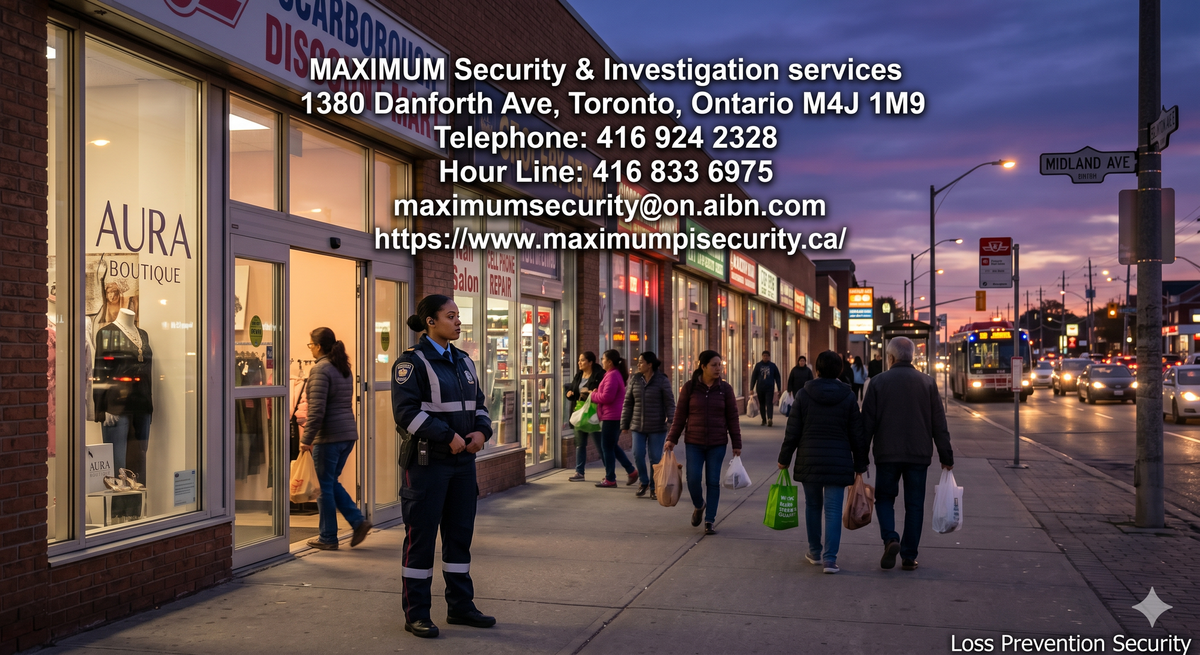
Operating a multi-unit retail storefront, specialty grocery, or commercial pharmacy in Scarborough—whether situated along the heavy commuter transit lines of Eglinton Avenue East, the dense retail pockets near Victoria Park and Ellesmere, or sprawling commercial corridors near Lawrence Avenue—presents unique vulnerability windows for local operators. While daytime shopping hours benefit from high foot traffic and full staff coverage, the operational dynamic shifts drastically as the sun goes down. The "twilight buffer"—the critical three-to-four-hour window right before closing—has become the highest-risk period for organized retail crime (ORC) syndicates, aggressive shoplifting, and targeted commercial break-and-enters across Toronto's east end.
Recent 2026 Toronto Police Service investigations have highlighted a massive surge in commercial retail crime throughout Scarborough, including sophisticated distraction thefts and serial break-and-enters targeting local business strips. Relying on reduced evening staffing, passive overhead cameras, or standard electronic door buzzers leaves your multi-unit operation completely exposed during these high-risk twilight hours. For retail owners and district managers, closing this vulnerability gap requires strategic shift-targeting. Deploying professional, uniformed evening security guards allows Scarborough retailers to fortify their storefronts during the most dangerous hours of the day, protect closing staff, and completely deter organized theft rings before they can strike.
The Operational Threat of the "Twilight Buffer"
The evening hours present a perfect storm of vulnerabilities for multi-unit retailers. Between 5:00 PM and 9:00 PM, store staffing levels naturally drop as daytime employees clock out. Simultaneously, management is heavily distracted by end-of-day administrative duties, cash register reconciliations, and inventory counts. Organized retail thieves understand this operational rhythm perfectly; they specifically target Scarborough storefronts during the twilight buffer because they know the remaining staff are stretched too thin to actively monitor the sales floor.
Consensus Analysis: Locked Doors vs. Active Evening Deterrence
When district managers attempt to curb late-day retail shrinkage, they frequently debate whether to simply restrict store access or invest in a targeted, physical human deterrent.
The Verdict:
- Avoid This: Implementing a "locked door buzzer" policy during the final hours of operation while leaving the floor unstaffed by security. While a buzzer stops random walk-ins, it creates a hostile, unwelcoming environment for legitimate evening shoppers. Furthermore, sophisticated ORC groups simply wait for a legitimate customer to be buzzed in and piggyback through the door, trapping your skeletal evening staff inside with an aggressive theft ring.
- Buy This: Station a professional, crisply uniformed security guard directly at the primary entrance specifically for the evening shift (e.g., 5:00 PM to 10:00 PM). This "shift-targeting" strategy is highly cost-effective. It places a dedicated, physical deterrent at your door during the exact hours when your store is most vulnerable, completely neutralizing the operational advantage that twilight shoplifters rely on, without paying for security during low-risk morning hours.
Calculating the True Financial Cost of Evening Retail Crime
The economic devastation caused by twilight retail theft and late-night commercial break-and-enters extends exponentially past the direct wholesale cost of the stolen merchandise. When a Scarborough retail location is repeatedly targeted during the evening, the entire operational health of the business declines.
If evening employees feel unsafe dealing with aggressive shoplifters or managing the store closing procedures alone, staff morale plummets. Retailers will face massive turnover rates specifically for their closing shifts, forcing corporate HR to spend thousands of dollars continuously recruiting and offering heavy premium wages just to staff the store at night. Furthermore, if a theft group returns after closing to execute a smash-and-grab—a trend heavily documented in recent Scarborough commercial break-in sprees—the business faces thousands of dollars in emergency glass remediation and lost operational downtime the following morning.
| Evening Loss Component | Unsecured Scarborough Storefront | Fortified Evening Guard Deployment |
| Direct Twilight Inventory Loss (Monthly) | $4,500 - $9,000 (CAD) | $0.00 (Theft Deterred) |
| Closing Shift Staff Turnover Costs | $5,500 (CAD per quarter) | $0.00 (Safe Workplace Maintained) |
| Emergency After-Hours Glass Remediation | $2,000 - $5,000 (CAD) | $0.00 (No Vandalism Sustained) |
| Lost Legitimate Evening Sales | Estimated 15% drop in traffic | $0.00 (Maintained Community Trust) |
| Total Estimated Financial Impact | $12,000 - $19,500+ (CAD) | $0.00 |
By deploying a professional evening security presence, retail owners immediately signal that the business is actively monitored during its most vulnerable hours. This targeted investment is mathematically superior to absorbing the compounding losses generated by an unprotected twilight shift. Retail managers looking to understand how these procurement principles scale across different commercial environments should review our foundational manual on construction site security guidelines for GTA contractors to verify baseline risk management workflows.
Engineering an Ironclad Evening Defense Strategy
Eliminating organized retail crime in a Scarborough multi-unit operation requires a dynamic security layout that actively controls the front entrance while securing the logistical blind spots at the rear of the property.
1. Shift-Targeted Front Entrance Deterrence
Your primary security asset must be positioned to maximize visual deterrence as soon as the sun begins to set. Station your uniformed guard within the immediate entrance foyer, directly adjacent to the main cash wraps. As evening approaches and exterior visibility drops, the brightly lit interior of the store makes the guard highly visible to anyone scouting the property from the street or the parking lot.
The guard executes proactive "greet and observe" tactics. By making immediate eye contact and offering a professional greeting to every person who enters the store during the evening hours, the guard shatters the anonymity that professional retail thieves require. If a scout team realizes they have been instantly identified and are being actively monitored by a uniformed professional, they will almost universally abandon their operational plan. For luxury or specialty locations seeking specialized guarding models, incorporating the protocols in our guide on uniformed loss prevention guards for luxury retail in Yorkville provides excellent context for premium storefront protection.
2. Securing the Closing Procedures and Cash Handling
The most dangerous 30 minutes for any retail operation is the final closing procedure. During this window, the front doors are locked, the cash drawers are open, and the day's deposits are being prepared for the safe.
An evening security guard completely secures this high-risk procedure. While the retail manager counts the cash in the back office, the guard maintains a static overwatch at the front of the store, ensuring that no lingering customers remain hidden in the aisles and that the perimeter doors are fully secured against late-night forceful entry attempts. Furthermore, the guard provides a safe physical escort for the closing staff as they walk to their vehicles in the dark parking lot or walk to the nearby TTC transit stops along Eglinton Avenue, significantly boosting employee retention and safety.
3. Fortifying Rear Loading Laneways and Staff Exits
Scarborough multi-unit retail strips frequently feature dual-exposure layouts: a primary storefront facing the avenue, and a dark, narrow rear laneway for shipping and staff exits. These rear laneways are notorious hotspots for aggressive loitering, illegal dumping, and late-night break-ins.
While your static guard secures the interior sales floor, integrating a randomized mobile security patrol service provides an exceptional, cost-effective defense for your exterior blind spots. A professional patrol officer in a marked, GPS-tracked security vehicle arrives at your rear laneway at completely unpredicted intervals throughout the twilight and overnight hours. The mobile officer physically checks rear doors, monitors staff parking areas for suspicious idling vehicles, and ensures that delivery bays remain completely secure. Property managers looking to evaluate the performance metrics between static coverage and shared vehicle services should study our comprehensive breakdown on hiring live guards vs. mobile patrols for Vaughan residential developments to optimize protection budgets.
Sourcing Verified B2B Retail Guarding in Scarborough
Acquiring professional security guard coverage for an evening retail shift requires a realistic understanding of commercial agency pricing structures across Toronto's east end. District managers cannot evaluate security proposals based on basic minimum-wage expectations. In the 2026 Ontario market, a legitimate, compliant security agency must operate under the strict guidelines of the Private Security and Investigative Services Act (PSISA), pricing contracts to cover extensive corporate overhead, including multi-million-dollar commercial general liability insurance, WSIB clearings, and rigorous conflict-de-escalation training for all deployed guards.
For active multi-unit retail storefronts across Scarborough, corporate procurement teams should budget for the following agency bill rates:
- Static Evening Retail Guard (Tier 1): Billed at $38.00 to $48.00 per hour (CAD). This involves a highly visible, customer-service-oriented guard deployed specifically for the 5:00 PM to 10:00 PM twilight shift, executing continuous floor patrols, securing cash-handling procedures, and providing safe staff escorts at closing.
- Elite Loss Prevention Specialist (Tier 2): Billed at $45.00 to $58.00 per hour (CAD). This involves a guard with advanced legal arrest training deployed strictly inside high-shrinkage multi-unit retailers (such as pharmacies or electronics stores) to interdict active theft rings before they can clear the exits.
- Randomized Mobile Vehicle Patrol (Tier 3): Billed at $45.00 to $75.00 per individual site check (CAD). This option provides unpredicted, thoroughly documented exterior sweeps for your rear laneways and staff parking areas after closing, presenting an outstanding balance of risk mitigation and cost containment.
Hiring an organization that quotes rates significantly below these commercial baselines—such as $22.00 to $25.00 per hour—is a direct indication that the provider is utilizing untrained personnel, operating without WSIB clearance, or failing to carry proper commercial liability insurance. If an uninsured, poorly trained guard injures a shoplifter in your Scarborough store, your corporate entity will bear 100% of the legal liability. To understand how to properly vet B2B vendors, reviewing our corporate guide on hiring uniformed security guards for retail plazas in Brampton is an essential step for any operations director.
If your Scarborough multi-unit operation, specialty grocery, or high-volume pharmacy requires an unyielding line of defense to eliminate evening shrinkage, establishing professional protection is straightforward. Retail operators can easily connect with verified B2B vendors to request a custom security quote from Maximum PI Security to deploy certified personnel, secure closing procedures, and protect valuable commercial assets against organized twilight threats.
Legal Realities and Compliance Under the Criminal Code of Canada
Deploying private security guards within a retail environment requires absolute adherence to Canadian law and provincial regulations to protect the business from severe civil lawsuits. Under section 494 of the Criminal Code of Canada, a licensed private security guard (acting as an authorized agent of the property owner) possesses the legal power to execute a citizen's arrest if they witness an individual committing an indictable offense, such as theft over $5,000.
However, to legally execute an arrest for shoplifting, the security guard must maintain continuous, uninterrupted surveillance of the suspect from the exact moment they select the merchandise to the moment they clear the final point of sale without paying. The guard must establish five distinct legal steps: Selection, Concealment, Continuous Observation, Failure to Pay, and Exterior Exit.
If a guard fails to maintain continuous observation for even a few seconds, executing an arrest introduces massive legal liabilities, as the suspect may have discarded the merchandise in a blind spot. Sourcing security through a verified firm adhering to strict training baselines is a fundamental risk-management step to protect your business from unlawful detention claims. For independent businesses looking to implement localized versions of these strategies, reviewing our neighborhood guide on Danforth Ave business security: stopping shoplifting and store vandalism provides excellent context on managing localized crime without massive corporate budgets.
Nitty-Gritty Evening Retail Realities
Can a retail guard legally physically block the door to stop a shoplifter from leaving?
While section 494 of the Criminal Code allows for a citizen's arrest, professional commercial security agencies strictly forbid guards from physically barricading doors or engaging in physical wrestling matches over standard retail merchandise. Blocking a door traps the suspect inside the store with innocent customers and staff, creating an extremely volatile and dangerous "cornered animal" scenario. If a suspect drops the merchandise and attempts to flee, the guard will allow them to exit, secure the recovered inventory, document the suspect’s description, and dispatch the Toronto Police Service. Life safety always supersedes asset recovery.
What should an evening guard do if a group of youths refuses to leave the store at closing time?
If a group is loitering and refuses to exit the store at closing, the guard operates under the authority of the Ontario Trespass to Property Act. The guard will approach the group professionally, state clearly that the store is now legally closed, and issue a formal verbal command to leave the private property. If the group becomes combative or continues to refuse, the guard will immediately retreat to a safe distance, instruct the retail staff to secure themselves in the back office, and instantly dial 911 to dispatch police to execute a formal trespassing removal.
Are retail stores legally responsible if an untrained shift supervisor injures a suspect during an evening interception?
Yes. Under the legal principle of vicarious liability, a retail store owner can be held entirely civilly responsible for the actions of their employees operating on the premises. If a shift supervisor chases a suspected shoplifter out into the Scarborough parking lot and utilizes improper physical force, the store can face direct, multi-million-dollar lawsuits for personal injury, assault, and false imprisonment. This is precisely why operations managers must explicitly prohibit their retail staff from physically intervening and instead partner exclusively with professional, fully insured security agencies.

Frequently Asked Questions
Why do organized retail crime groups use "steaming" or "flash mob" tactics?
"Steaming" involves a large, coordinated group of individuals rushing a store simultaneously to grab merchandise. This tactic is specifically designed to overwhelm skeletal evening retail staff and create sheer chaos, making it impossible for employees to physically intervene or accurately track who took what. A trained, uniformed security guard neutralizes this by acting as an immediate visual deterrent that forces these groups to reconsider their target before they even enter the doors.
Should we utilize plainclothes loss prevention officers or uniformed guards for evening shifts?
For the twilight buffer, a highly visible, uniformed security guard is almost always the optimal choice. The primary objective during the evening is pure visual deterrence and staff safety. You want potential thieves to see the guard from the street and decide to walk away. Plainclothes officers are excellent for daytime internal auditing, but they do nothing to project the visible authority needed to protect a skeletal evening staff from aggressive ORC incursions. For operators dealing with specific internal staff liabilities during closing procedures, reviewing our guide on how visible retail guards reduce employee theft in downtown Toronto provides excellent context on managing full-spectrum loss prevention.
How do we protect our glass storefronts after the security guard goes home at 10:00 PM?
To protect your Scarborough storefront deep into the overnight hours, operations managers must ensure all high-value electronics and cosmetics are removed from front window displays and locked in the rear safe at closing. Furthermore, integrating a randomized mobile patrol unit to conduct unpredicted vehicle sweeps of your storefront between midnight and 5:00 AM provides an active, highly effective deterrent against late-night smash-and-grab crews.
About the Author
Jeff Calixte is an online exclusive content sell strategist with a deep background in tracking local asset protection data, analyzing Southern Ontario labor rates, and outlining real operational deployment structures across the Greater Toronto Area.
Sources
- Criminal Code of Canada, R.S.C. 1985, c. C-46 - Section 494 Arrest Standards
- Ontario Ministry of the Solicitor General - Private Security and Investigative Services Act Regulations
- Toronto Police Service - Commercial Property Protection Advisories
Note
Commercial bill rates, guard wages, deployment conditions, and vendor availability can vary widely by province, municipality, season, and project scope. All pricing estimates, labor figures, and career examples in this guide are approximations based on current Ontario market data. Always confirm contract details, licensing compliance, and specific rate quotes directly with your chosen service provider or employer before finalizing any agreements.