How to Prevent Lumber and Material Theft in Brampton Subdivisions
Framing lumber and raw building materials are major targets for organized theft loops across Brampton. Discover the exact physical bundling standards and 2026 commercial guarding protocols to eliminate material loss.
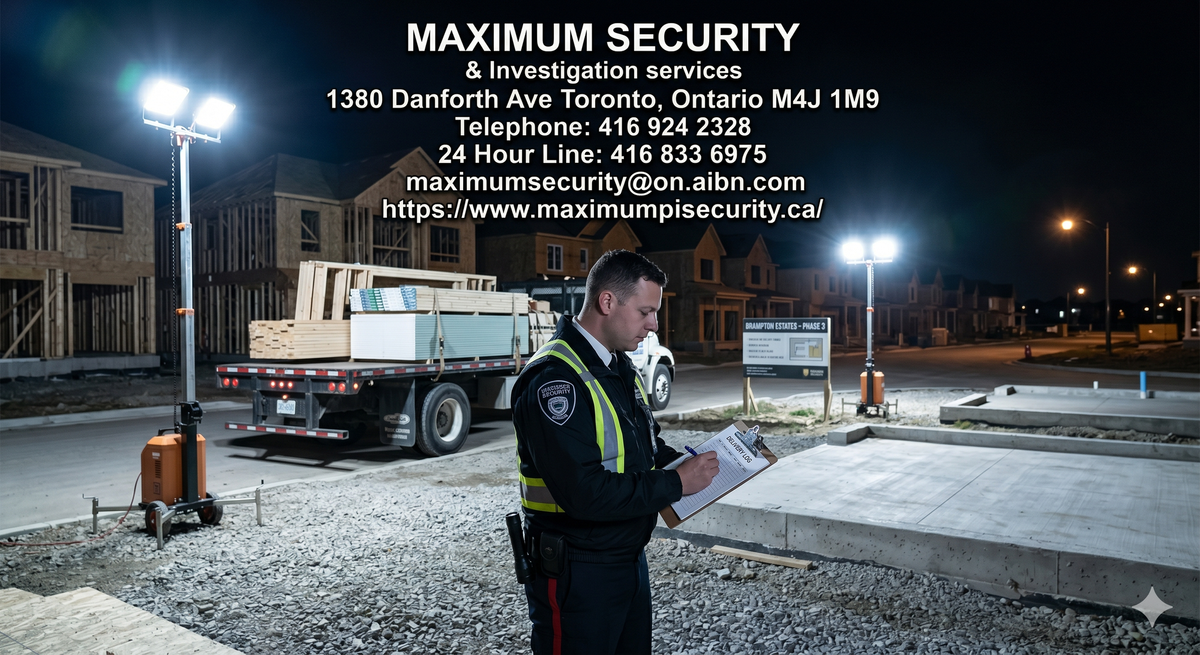
Securing residential subdivisions, infrastructure projects, and mid-rise developments across Brampton—ranging from expansive low-rise residential tracts near Mount Pleasant and Credit Valley to rapid commercial builds along Bovaird Drive, Hurontario Street, and Queen Street West—presents project developers with severe asset protection challenges. As massive framing blocks and structural footprints expand across Peel Region, raw construction materials—specifically dimensional framing lumber, plywood bundles, and roofing insulation packages—become primary targets for highly organized theft rings. These criminal operations exploit the highly liquid nature of raw lumber commodities, systematically targeting suburban building sites during vulnerable framing stages to strip thousands of dollars in material inventory overnight.
Relying on standard perimeter chain-link panels, basic padlocked access gates, or unmonitored security cameras provides minimal deterrence against experienced theft groups equipped with flatbeds and commercial trucks. For a primary developer, residential builder, or project superintendent, protecting these volatile material assets requires implementing industrial-grade physical binding protocols, engineering tight storage zones, and deploying professional on-site guarding solutions. Aligning your loss prevention strategies with proven field data protects your operating capital and prevents costly scheduling overruns.
The Operational Mechanics of Suburban Material Theft
Lumber and material theft across Brampton development corridors is rarely the work of impulsive passersby or minor opportunists. Field analysis across Southern Ontario reveals that organized material tracking networks systematically scout residential subdivisions during peak daylight hours. They track material delivery schedules, identify exactly which home lots are preparing for framing stages, map out dark perimeter approach vectors, and assess the movements of site supers and trade crews. When the site clears out at tool-drop, these teams pull directly onto unlit neighborhood streets to load unsecured bundles and clear the perimeter within minutes.
Consensus Analysis: Open Lot Staging vs. Centralized Material Compounds
Project supervisors often distribute raw lumber bundles directly beside individual home lots to optimize daytime trade efficiency and minimize secondary material handling.
The Verdict:
- Avoid This: Staging loose, un-banded framing packages or plywood sheets directly on individual residential house lots overnight before active framing crews are on-site. Leaving bulk commodities distributed across a wide, unlit subdivision footprint creates an impossible perimeter to secure, inviting quick drive-by thefts.
- Buy This: Establish a single, centralized material storage compound located directly within the primary line of sight of your central guard station. Consolidate all inbound delivery drops within this reinforced perimeter, and only distribute material packages to individual house lots on the exact morning active installation crews are scheduled to work.
Calculating the True Financial Fallout of Lumber Losses
The financial damage of bulk material theft extends far past the direct replacement invoice of a stolen framing package or plywood bundle. When a major asset compound is breached and stripped overnight, the residential builder faces a cascading disruption to their critical path construction schedule. If a framing sub-contractor arrives on-site at 7:00 AM only to discover that their scheduled lumber packages have been stolen, production shuts down completely.
Because skilled trades operate on tight schedules and navigate massive backlogs across the GTA, you cannot simply instruct a framing crew to wait around unpaid while you source replacement inventory from a supplier down on Steeles Avenue. Under standard Ontario trade agreements, the primary builder remains responsible for daily trade wages even when zero structural progress occurs. A single day of complete trade downtime for an entire framing crew can quickly drain thousands of dollars in unrecoverable labor outlays.
| Loss Allocation Factor | Standard Unsecured Lot Staging | Fortified Centralized Staging |
| Material Replacement Invoice (CAD) | $12,500 - $24,000 | $0.00 (Breach Deterred) |
| Framing Crew Labor Downtime (1.5 Days) | $6,500 (CAD) | $0.00 (Continuous Build) |
| Emergency Logistics & Re-Order Fees | $2,200 (CAD) | $0.00 (Normal Delivery) |
| Builders' Risk Insurance Deductible | $2,500 (CAD) | $0.00 (No Claim Filed) |
| Project Delay Penalty/Liquidated Damages | Applicable under contract terms | $0.00 (On-Schedule Target) |
| Total Estimated Financial Impact | $23,700 - $35,200+ (CAD) | $0.00 |
Furthermore, multiple high-value material claims submitted to commercial builders' risk insurance carriers can cause annual premium rates to escalate or lead to total policy cancellations. If missing framing components delay critical inspections, rough-ins, or roof enclosures before a heavy winter storm, the builder faces severe structural damage risks and financial penalties for missing closing deadlines. Sourcing professional, proactive security guarding services is a highly predictable, mathematically superior alternative to absorbing the heavy logistical fallout of an unsecured compound.
Contractors looking to establish foundational security baselines across broad provincial frameworks should review our comprehensive 2026 construction site security guidelines for GTA contractors to verify code-compliant protection.
Designing an Ironclad Material Protection Blueprint
Eliminating raw material theft in expanding suburban developments requires a layered defense strategy that combines physical immobilization tactics with dynamic perimeter surveillance.
1. High-Tensile Steel Banding and Strategic Staging
Superintendents must abandon standard plastic strapping for bulk inventory storage. All dimensional lumber, plywood, and sheeting bundles held in your centralized compound must be bound tightly using high-tensile steel strapping applied with pneumatic tensioning tools. Steel bands cannot be cut with basic utility knives or hand tools, forcing thieves to use loud, heavy metal-cutters that eliminate the speed and silence they rely on.
Additionally, apply CPTED (Crime Prevention Through Environmental Design) principles to your lot staging. Never stack bulk lumber packages along outer perimeter fence lines where they can act as a natural ladder for intruders. Ensure all high-value materials are surrounded by inward-facing, high-efficiency LED floodlighting arrays to eliminate dark zones. Contractors can further fortify on-site logistics by implementing the advanced lock standards detailed in our specific regional blueprint on preventing overnight tool theft on East York construction sites.
2. Physical Blockades and Heavy Equipment Staging
Experienced material thieves easily hook up and tow away mobile trailers or load flatbeds quickly. To prevent unauthorized vehicle entry, site supers must utilize heavy machinery as active physical blockades at the end of every day shift.
Park heavy, fully locked excavators, skid steers, or front loaders directly across the interior line of your primary access gates, and lower all buckets and blades flat to the ground. This physical barrier prevents transport vehicles from executing quick breaches, forcing intruders to spend significant time attempting to move heavy machinery without keys. For developers seeking to evaluate alternative mobile check frameworks across large residential parcels, studying our detailed analysis on hiring live guards vs. mobile patrols for Vaughan residential developments outlines critical procurement metrics.
3. Deploying Full-Time Static Guarding and Perimeter Controls
Sprawling residential developments and high-volume construction zones in Brampton require an uninterrupted physical security presence to counter organized property crime. A licensed, professional static security guard stationed on-site throughout overnight and weekend windows ensures your valuable building components remain under continuous visual monitoring.
The guard manages access gates, verifies incoming trade manifests, and conducts regular perimeter checks to ensure fencing panels have not been compromised. For project teams facing elevated rates of property damage or unauthorized site access during framing phases, combining these static guards with the deterrent frameworks in our guide on dealing with vandalism at Scarborough commercial build sites ensures your perimeters remain highly defended.
Sourcing Verified Commercial Guarding Services in Peel Region
Acquiring external security guard coverage requires a realistic understanding of commercial agency pricing structures across Southern Ontario. Project procurement teams often confuse entry-level hourly guard wages with the final commercial invoice rate billed by a fully insured security business. In 2026, a legitimate, compliant security agency must operate under the strict guidelines of the Private Security and Investigative Services Act (PSISA), pricing contracts to cover substantial corporate infrastructure, including multi-million-dollar commercial general liability insurance, comprehensive WSIB clearings, vehicle fleet maintenance, and 24/7 centralized command centers.
For active commercial developments or residential subdivisions in Brampton, contractors should budget for the following commercial agency bill rates:
- Static Overnight Foot Patrol Guard (Tier 1): Billed at $38.00 to $48.00 per hour (CAD). This involves a dedicated guard stationed continuously on your property for a full 10-to-12-hour shift, executing continuous physical perimeter patrols and maintaining a digital incident logbook.
- Premium Access Control Guard (Tier 2): Billed at $45.00 to $58.00 per hour (CAD). This involves a specialized guard managing heavy shipping gates, executing manifest audits, and enforcing site compliance during active delivery hours.
If your active residential subdivision, commercial infrastructure project, or material asset yard along the Brampton development corridor demands immediate, unyielding protection against material theft loops, establishing a professional line of defense is simple. Project superintendents can seamlessly connect with proven local operators to request a custom security quote from Maximum PI Security to deploy high-visibility assets, manage primary access gates, and eliminate liability vulnerabilities before they trigger severe operational delays.
Compliance and Liability Management under the PSISA
Sourcing private security guard forces for an active development property requires strict adherence to Ontario provincial regulations to insulate the primary contractor from severe civil liability and regulatory penalties. Under the Private Security and Investigative Services Act, every individual performing security, gate watch, or property patrol duties must hold an active Ontario Security Guard Licence card.
Some builders attempt to save money by paying off-duty laborers cash to sit in a vehicle and watch materials overnight. This practice introduces massive legal risks. Unlicensed workers lack the formal training required to manage trespassers properly under the Trespass to Property Act (TPA). If an unlicensed worker gets into a physical altercation with a material thief and sustains an injury, your commercial liability insurance provider will likely invalidate your entire policy due to a breach of risk warranties. Your business will face immediate workplace safety investigations, heavy provincial fines, and potentially devastating civil lawsuits. Sourcing security through a verified firm adhering to strict training baselines—such as those detailed in our guide on construction site security guard requirements in North York—is a fundamental risk-management step.
Nitty-Gritty Material Theft Answers
Can a Brampton builder legally use remote trail cameras hidden in trees to monitor lumber stacks?
Yes. Installing battery-powered, cellular-enabled trail cameras hidden along your perimeter or directed at high-value material stacks is a legal and highly effective method to capture real-time evidence of a breach. However, to comply with privacy laws and ensure the evidence is admissible in an Ontario court, you must display high-visibility signage at your primary entry gates stating that the property is under active 24/7 video surveillance.
What should an overnight guard do if they spot an unauthorized flatbed truck loading lumber from a remote lot?
If a guard or supervisor encounters an active material theft in progress on a remote lot, the absolute protocol is to prioritize personal safety and avoid direct physical confrontation. Organized material thieves operate in groups and frequently carry heavy tools like crowbars, tire irons, or blades. The guard must immediately retreat to a position of safety, utilize their mobile application to document the vehicle's make, color, and license coordinates, and instantly contact 911 to dispatch the Peel Regional Police.
Are security guards legally authorized to check the driver's licenses of delivery drivers entering a subdivision?
Yes. A licensed security guard acting as an authorized agent of the property developer has the full legal right under the Trespass to Property Act to demand valid identification, verify commercial delivery manifests, and check vehicle logbooks before granting access to the private property. If a driver refuses to provide identification or verify their manifest, the guard can legally deny them entry and direct them to leave the premises immediately.
Frequently Asked Questions
Why has lumber theft shifted from a crime of opportunity into an organized tracking market?
Lumber packages are highly targeted because raw building materials are expensive, standard commodities that lack serial numbers or distinct tracking features. Once a bundle of dimensional lumber or plywood is removed from your site, it can be easily resold to gray-market contractors or listed on local classified sites like Kijiji within hours, making physical tracing exceptionally difficult for local police divisions.
What is the legal framework governing private security guards enforcing the TPA after hours?
Under the Ontario Trespass to Property Act, private security guards serve as official representatives of the property owner. This grants them the full legal power to challenge unauthorized individuals, demand identification, deny entry, and formally direct trespassers to leave the property immediately.
Should we utilize GPS tracking tags inside bulk lumber packages?
Yes. Embedding weatherproof, battery-powered GPS tracking tags deeply within the center of high-value lumber packages or under plywood stacks is a highly effective method to mitigate loss. If a bundle is stolen, these devices transmit live location streams directly to your security provider and local police divisions, allowing law enforcement to intercept the suspects and execute a lawful recovery.
About the Author
Jeff Calixte is an online exclusive content sell strategist with a deep background in tracking local asset protection data, analyzing Southern Ontario labor rates, and outlining real operational deployment structures across the Greater Toronto Area.
Sources
- Ontario Ministry of the Solicitor General - Private Security and Investigative Services Act Regulations
- Trespass to Property Act, R.S.O. 1990, c. T.21
- Peel Regional Police - Commercial Property Protection and Crime Prevention Advisories
Note
Commercial bill rates, guard wages, deployment conditions, and vendor availability can vary widely by province, municipality, season, and project scope. All pricing estimates, labor figures, and career examples in this guide are approximations based on current Ontario market data. Always confirm contract details, licensing compliance, and specific rate quotes directly with your chosen service provider or employer before finalizing any agreements.