Crowd Control Security Requirements for Outdoor Festivals in Mississauga
Securing a special event permit for an outdoor festival in Mississauga requires strict adherence to municipal security mandates. Discover the legal guard ratios, AGCO liquor compliance strategies, and physical perimeter requirements needed to satisfy city regulators and protect your attendees.
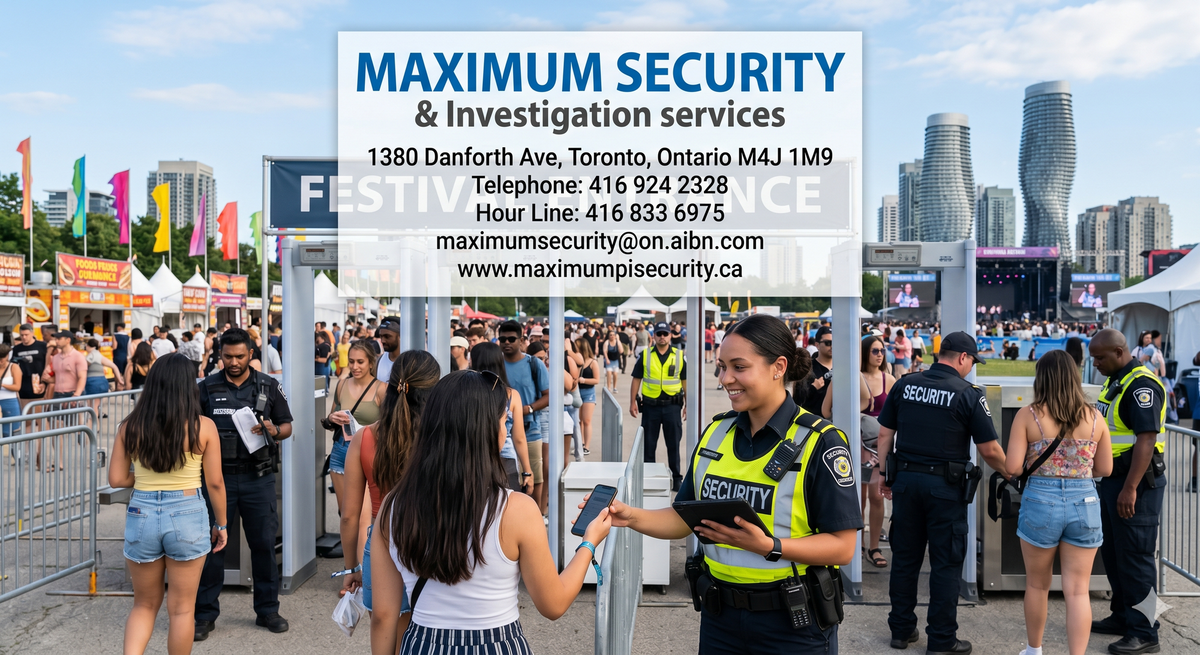
Organizing a large-scale outdoor festival in Mississauga—whether it is a cultural parade through Port Credit, a food truck rally at Celebration Square, or a massive concert on the grounds of the International Centre—is a massive logistical undertaking. Before a single ticket is sold or a tent is erected, event organizers must secure a Special Event Permit from the City of Mississauga. Securing this permit is not merely a bureaucratic formality; it is a rigorous review process heavily scrutinized by Peel Regional Police, Mississauga Fire and Emergency Services, and the Alcohol and Gaming Commission of Ontario (AGCO).
Municipal regulators view massive outdoor gatherings as high-risk liability events. If an organizer cannot definitively prove they have a structured, professionally managed security plan in place, the city will deny the permit. Relying on volunteer ushers, committee members, or uncertified event staff to manage a crowd of five thousand people is legally unacceptable in Peel Region. To obtain approval, organizers must deploy licensed, third-party security professionals who understand the exact municipal compliance metrics for perimeter control, emergency egress, and liquor enforcement. For a foundational understanding of how these compliance structures dictate operational planning, reviewing How to Plan Special Event Security for GTA Venues provides organizers with the blueprint required to align their budgets with municipal mandates.
The operational reality in Mississauga is that the municipality holds the event organizer entirely liable for the safety of the public. If a physical altercation breaks out in the beer garden, or if a severe weather event necessitates an immediate evacuation, the city demands a rapid, coordinated response from trained personnel. Meeting these requirements means understanding the specific guard-to-attendee ratios and the tactical deployment strategies necessary to maintain order in a chaotic, open-air environment.
The Consensus Verdict on Compliance Ratios
Field data and municipal permitting history consistently reveal that event organizers who attempt to submit security plans utilizing less than a 1-to-100 guard-to-attendee ratio face a 90% permit rejection rate from Peel Regional Police for high-capacity events involving alcohol. Event directors must mandate a baseline deployment of at least one licensed security professional per 100 expected attendees, and explicitly avoid attempting to count volunteer staff toward this legal compliance metric.
Mandated AGCO Compliance and Liquor Liability
The most heavily scrutinized element of any Mississauga festival permit is the service of alcohol. If your event includes a licensed beer garden or open alcohol service under a Special Occasion Permit (SOP), the AGCO and the municipality demand a completely segregated security strategy. The legal liability of over-serving patrons or allowing underage consumption rests squarely on the permit holder.
Standard operational plans must include dedicated AGCO enforcement guards. These guards cannot be tasked with general ticket scanning or managing the main stage; their sole mandate is monitoring the licensed area. They must actively patrol the perimeter of the beer garden to prevent attendees from passing alcohol through the fencing to underage individuals. Furthermore, they are legally required to intercept visibly intoxicated patrons, preventing them from accessing the bar and de-escalating potential conflicts before they erupt into physical violence. The aggressive enforcement of these liquor laws is identical to the protocols required to secure massive private functions, a necessity explored in Hiring Licensed Wedding Security Guards for Brampton Banquet Halls.
Estimated Mississauga Festival Compliance Guard Tiers in CAD
| Security Function | Municipal Compliance Focus | Estimated Hourly Bill Rate (CAD) | Principal Regulatory Target |
| Access Control Specialist | Perimeter enforcement, bag checks, capacity counting | $25.00 - $30.00 | Fire code limits, contraband entry |
| AGCO Liquor Enforcer | ID verification, intoxication intercepts, barrier monitoring | $28.00 - $35.00 | Underage drinking, SOP violations |
| Crowd Dynamics Manager | Density monitoring, emergency egress clearing, physical de-escalation | $30.00 - $38.00 | Compressive asphyxiation, medical extraction delays |
Perimeter Hardening and Physical Boundary Requirements
A fundamental requirement for obtaining a Special Event Permit in Mississauga is the establishment of a defined, secure perimeter. The city requires organizers to submit a scaled site map detailing exactly how the public space will be enclosed. Utilizing simple plastic snow fencing or caution tape is instantly rejected by municipal planners, as it provides zero physical barrier against gate-crashers or crowd surges.
Organizers must utilize rigid, interlocking steel barricades (Mojo barriers) or heavy-duty chain-link fencing for the primary boundaries. However, a fence is only a delay mechanism; it is not a complete security solution. Licensed security guards must be strategically positioned along the interior perimeter to actively monitor for breaches. If an unauthorized individual attempts to jump the fence, the guard must intercept them immediately. This active perimeter enforcement demonstrates to the municipality that the organizer has absolute control over the venue’s capacity, ensuring compliance with strict fire code limitations.
Advanced Municipal Compliance, Mass Egress, and Hostile Vehicle Mitigation
Securing a municipal permit for a massive outdoor festival in Mississauga requires a highly technical approach to risk mitigation that goes far beyond checking tickets at the gate. City officials—including Peel Regional Police, the Fire Marshal, and the AGCO—require detailed operational plans that address worst-case scenarios. This section explores the zero-competition strategies required to satisfy complex municipal mandates, manage severe crowd dynamics, and protect the public from external threats.
Meeting and Exceeding Municipal Guard-to-Attendee Ratios
When submitting a Special Event application to the City of Mississauga, the most scrutinized metric is the guard-to-attendee ratio. The baseline standard across Ontario is typically one licensed security guard for every 100 attendees for a standard, low-risk event. However, this ratio is not static. Peel Regional Police and the AGCO will force organizers to increase the security deployment if the event's risk profile escalates.
Organizers must anticipate mandatory ratio increases based on the following factors:
- Alcohol Service: Events with sprawling beer gardens or open alcohol service frequently require a 1:75 or even 1:50 ratio within the licensed zones to manage intoxication levels.
- Event Duration: Events operating late into the evening (past 9:00 PM) require higher ratios due to decreased visibility and increased fatigue among attendees.
- Demographics and Entertainment: A classical music festival will require a standard ratio; a high-energy electronic dance music (EDM) festival or a heavy metal concert will trigger demands for a significantly heavier tactical security presence to manage mosh pits and physical crowd surges.
Security providers must submit a detailed deployment schedule to the city, proving that the exact number of licensed personnel will be on-site at all times. Attempting to artificially inflate these numbers by substituting untrained volunteers for licensed guards is a direct violation of the permit conditions and will result in an immediate shutdown by municipal inspectors.
Executing Mandated Medical Extraction and Egress Corridors
A critical component of fire and police approval is the establishment of emergency egress and medical extraction routes. When a medical emergency occurs deep within a crowd of ten thousand people at Celebration Square, Peel Paramedics cannot physically push a stretcher through the density. If the response is delayed because the crowd cannot be moved, the city holds the organizer liable.
Security directors must engineer dedicated medical extraction corridors into the venue layout before the first fence panel is erected. These are physically barricaded, sterile lanes that run from the deepest parts of the crowd directly to the medical staging tents or ambulance bays. These lanes cannot be used for standard pedestrian traffic. When an incident occurs, crowd management guards locate the victim, secure a perimeter around them, and rapidly extract them via the sterile corridor. This ensures paramedics have immediate, unimpeded access to the patient, satisfying the strict life-safety mandates of Mississauga Fire and Emergency Services.
Deploying Mandatory Hostile Vehicle Mitigation (HVM) Assets
In the modern landscape of event management, the threat of a hostile vehicle intentionally or accidentally breaching a dense pedestrian crowd is a severe concern for municipal planners. Festivals involving temporary street closures, such as cultural parades through Port Credit, or events utilizing open parking lots, are highly vulnerable to vehicular incursions.
The City of Mississauga will not approve a street closure permit if the organizer simply plans to use orange traffic cones or wooden sawhorses to block live traffic lanes. Professional outdoor event security requires the deployment of engineered Hostile Vehicle Mitigation (HVM) assets. This includes positioning heavy municipal sanitation trucks, water-filled jersey barriers, or engineered mobile crash barriers across every active roadway intersecting the pedestrian footprint. Security guards stationed at these barricades control the limited access for authorized emergency vehicles, ensuring the pedestrian zone remains completely isolated from unauthorized vehicular traffic. This aggressive hardening mirrors the physical access control logic required for managing sprawling industrial sites, an operational standard detailed in Mobile Security Patrol Services for Industrial Parks in Mississauga.
Managing Crowd Density and Compressive Asphyxiation Risks
For high-capacity concerts, the area directly in front of the main stage is a massive liability zone. Crowd dynamics are highly fluid. As a headline act takes the stage, the sheer physical pressure of the crowd surging forward can cause compressive asphyxiation—where individuals are crushed against the barricade and cannot expand their lungs.
Licensed crowd management guards are specifically trained to monitor and control density levels to prevent this fatal phenomenon. Guards stationed in the "pit" (the area between the stage and the front barricade) do not watch the performance; they face the crowd continuously, actively scanning for signs of distress, panic, or individuals collapsing. If a specific zone becomes dangerously compressed, the security team must execute a coordinated "crowd split," using physical presence and high-intensity lighting to force the crowd to step back and disperse laterally. This active management is a mandatory requirement for any concert permit in Peel Region, ensuring the environment remains structurally safe. The tactics for managing this pressure are deeply aligned with the strategies explored in Festival and Outdoor Event Crowd Control Security in Mississauga.
Enforcing Strict Contraband and Weapons Screening at Entry
To satisfy Peel Regional Police requirements, organizers must demonstrate a proactive strategy for keeping prohibited items out of the venue. A porous front gate guarantees that weapons, illegal narcotics, and outside alcohol will enter the festival footprint, immediately violating the terms of the Special Event Permit.
Professional security teams utilize structured access control checkpoints designed for high-throughput screening. This involves deploying wide, multi-lane access points equipped with physical switchback stanchions (to slow the crowd approach) and dedicated bag-check tables. Every attendee is subjected to a mandatory bag search and, depending on the risk profile of the event, physical wanding with a metal detector. By establishing a rigorous, visible screening process at the property line, the security team intercepts threats before they enter the crowd, satisfying the municipality's demand for a safe, sterile event environment.
Securing the Teardown Phase and Post-Event Municipal Handoff
The liability of the event organizer does not end when the final band stops playing. The "teardown" phase is a highly vulnerable window where thousands of attendees are simultaneously flooding onto municipal sidewalks and roadways, creating severe traffic bottlenecks and public safety risks.
The security team's mandate includes managing the mass egress. Guards must be strategically positioned outside the venue gates to direct pedestrian traffic away from live roadways, coordinate with public transit officials, and ensure the crowd disperses safely and rapidly. Furthermore, the interior security team must lock down the venue perimeter, ensuring that only authorized third-party vendors with verified teardown credentials remain on site to dismantle the heavy staging equipment. The security operation only concludes when the venue is completely sterile, the vendors have departed, and the property is officially handed back to the municipal parks department without incident.
If your organization is planning a major outdoor festival, a cultural parade, or a high-capacity public gathering in Mississauga, request a custom security quote from Maximum PI Security to ensure your security plan meets all municipal compliance mandates and your permit is approved.

Frequently Asked Questions
Do I legally need to hire security guards for an outdoor festival in Mississauga?
Yes. If your event requires a Special Event Permit from the City of Mississauga, expects a large capacity, involves temporary street closures, or includes the service of alcohol under an AGCO permit, the municipality will mandate the hiring of licensed, third-party security guards. Failure to provide a comprehensive, professionally managed security plan will result in the immediate rejection of your permit application by Peel Regional Police and city planners.
How many security guards do I need to get my event permit approved?
The baseline industry standard required by most municipalities in Ontario is one licensed security guard for every 100 expected attendees. However, Peel Regional Police and the AGCO frequently require higher ratios (e.g., 1 guard per 75 or 50 attendees) if your event features sprawling beer gardens, operates late at night, or features high-energy entertainment that increases the risk of crowd surges and physical altercations.
Can festival security guards legally search bags at the entrance?
Absolutely. Entering a ticketed or permitted outdoor event is a conditional agreement. The event organizer establishes the rules of entry, which explicitly mandate bag searches to prevent weapons, illegal narcotics, and outside alcohol from entering the venue. If an attendee refuses to consent to the bag search, the licensed security guard has the legal authority under the Ontario Trespass to Property Act to deny them entry and direct them to leave the municipal property boundary immediately.
A licensed event security guard ensures the compliance of outdoor festivals in Mississauga by executing strict perimeter bag checks to satisfy police mandates, continuously monitoring crowd density to prevent crush zones, and aggressively enforcing AGCO liquor laws within licensed beer gardens. Operating under the Ontario Trespass to Property Act, these professional teams provide the physical enforcement required to execute safe mass evacuations, manage Hostile Vehicle Mitigation barricades, and guarantee that the event organizer fulfills every legal liability requirement demanded by city regulators.
About the Author
Jeff Calixte is an online exclusive content sell strategist with a deep background in tracking local asset protection data, analyzing Southern Ontario labor rates, and outlining real operational deployment structures across the Greater Toronto Area.
Sources
- Alcohol and Gaming Commission of Ontario (AGCO) - Special Occasion Permits
- Peel Regional Police - Special Event and Paid Duty Guidelines
- City of Mississauga - Special Events Permitting Guidelines
Note
Commercial bill rates, guard wages, deployment conditions, and vendor availability can vary widely by province, municipality, season, and project scope. All pricing estimates, labor figures, and career examples in this guide are approximations based on current Ontario market data. Always confirm contract details, licensing compliance, and specific rate quotes directly with your chosen service provider or employer before finalizing any agreements.