Condo Parking Enforcement Security Guards in Mississauga: Guide
Unauthorized visitor parking and garage misuse create risks for Mississauga condos. Learn how security guards enforce parking rules, document violations, follow towing bylaws, and use digital reporting to protect resident parking and improve community safety.
The skyline of Mississauga has transformed dramatically over the last decade. With massive, high-density residential condominium developments surging around the Square One district, the Hurontario LRT corridor, and the waterfront communities of Port Credit, the city is experiencing unprecedented vertical growth. However, with this massive influx of residents comes a severe, localized logistical nightmare that plagues almost every property management group and condo board in the region: residential parking abuse.
In a high-rise Mississauga condominium, parking is a premium, highly restricted asset. Underground resident spaces are strictly deeded, and above-ground visitor parking spots are severely limited by municipal zoning bylaws. When non-residents utilize visitor parking to commute to nearby offices, when residents illegally park their secondary vehicles in visitor zones for days at a time, or when delivery trucks chronically block designated fire routes, the entire community suffers. Residents become infuriated when their legitimate guests cannot find parking, leading to aggressive confrontations in the lobby and a massive drain on the property manager's daily administrative time.
Relying on passive paper parking passes, easily manipulated dashboard permits, or the honor system is completely ineffective against chronic parking abusers. To eliminate unauthorized vehicles and restore order to the community, Mississauga condo boards are deploying specialized, MLEO-certified (Municipal Law Enforcement Officer) condominium security guards. By integrating digital license plate scanning, routine subterranean patrols, and strict municipal towing protocols, dedicated security personnel transform chaotic parking facilities into highly regulated, secure, and revenue-neutral assets for the condominium corporation.
What is Condo Parking Enforcement Security?
Condo parking enforcement security is the deployment of licensed, uniformed security guards to regulate and monitor residential parking facilities. These guards utilize digital visitor registration software to verify authorized vehicles, execute routine patrols of visitor lots and underground garages, and issue legally binding municipal parking infractions (if MLEO-certified) or coordinate private property towing for vehicles violating the condominium corporation's bylaws, ensuring strict access control and fair usage of limited parking assets.
The Financial and Operational Reality of Condo Parking Abuse
Parking abuse is not merely a resident annoyance; it is a massive operational liability that impacts the safety, financial health, and legal standing of the condominium corporation.
Consensus Analysis: Passive Warning Notes vs. Active Guard Enforcement
When condo boards first attempt to tackle rampant parking abuse, they frequently debate the severity of their response, balancing resident relations against the need for strict enforcement.
The Verdict:
- Avoid This: Relying on the property manager or the building superintendent to place passive, handwritten "Warning" notes under the windshield wipers of unauthorized vehicles. Chronic parking abusers completely ignore paper warnings. If there is no financial penalty or immediate threat of a tow, the abuser realizes the building lacks teeth. Furthermore, forcing a superintendent to confront a hostile resident over a parking spot redirects them from critical building maintenance tasks and exposes them to unnecessary workplace harassment.
- Buy This: Implement a strict, digital parking enforcement protocol managed entirely by a third-party, uniformed security guard. The guard removes the emotion from the interaction. They do not write warnings; they scan the license plate, verify it against the digital visitor registry, and if the vehicle is unauthorized, they immediately issue a municipal parking ticket (if trained) or tag the vehicle for an authorized tow. This immediate, objective enforcement rapidly alters the behavior of the community, eradicating repeat offenders within weeks.
Calculating the True Cost of Unmanaged Condominium Parking
The economic and liability costs associated with poorly managed condominium parking facilities in Mississauga are severe and compounding.
When designated visitor spots are constantly monopolized by unauthorized commuters or residents storing uninsured vehicles, legitimate guests are forced to park on adjacent city streets, risking municipal fines themselves. This directly degrades the luxury living experience of the building, prompting resident outrage at Annual General Meetings (AGMs).
More critically, parking abuse introduces massive life-safety liabilities. Delivery drivers (such as Amazon, UberEats, or heavy furniture movers) who cannot find temporary parking will frequently idle their vehicles directly in the building's designated fire route or block the underground garage ramp. If a medical emergency or a structural fire occurs, and a blocked fire route delays the arrival of Peel Regional Paramedics or Mississauga Fire and Emergency Services by even two minutes, the condominium corporation faces devastating, multi-million-dollar negligence lawsuits and severe municipal fines under the Ontario Fire Code.
| Operational Failure | Unmanaged Condominium Parking | Guard-Enforced Parking Protocol |
| Fire Route Obstruction Fines | $500 - $1,000+ (CAD per municipal fine) | $0.00 (Fire routes kept strictly clear) |
| Resident Turnover / Satisfaction Drop | High (Severe daily frustration) | Low (Guaranteed guest parking access) |
| Property Manager Wasted Hours | $1,500+ (CAD monthly in wasted salary) | $0.00 (Outsourced to Security) |
| Vandalism / Auto Theft Risk | High (Unmonitored garage access) | Low (Routine subterranean patrols) |
| Total Estimated Financial Impact | Severe structural liabilities | Secure, orderly operations |
By deploying a professional security presence tasked with rigid parking enforcement, condo boards protect the physical safety of their residents, ensure compliance with the Ontario Fire Code, and reclaim the property manager's valuable time. For property managers looking to understand how these targeted deployment strategies scale to broader community protection, reviewing our foundational manual on condominium concierge security management and GTA board guides provides excellent insight into holistic high-rise security frameworks.
Engineering an Ironclad Parking Enforcement Strategy
Eradicating parking abuse in a high-density Mississauga development requires a highly systematic, technology-driven approach. The days of logging license plates with a pen and clipboard are entirely dead. Modern enforcement relies on digital verification and relentless consistency.
1. Digital Visitor Registration and Plate Scanning
The foundation of effective enforcement is shifting the burden of registration entirely onto the resident. The condominium board must implement a centralized, cloud-based visitor parking software.
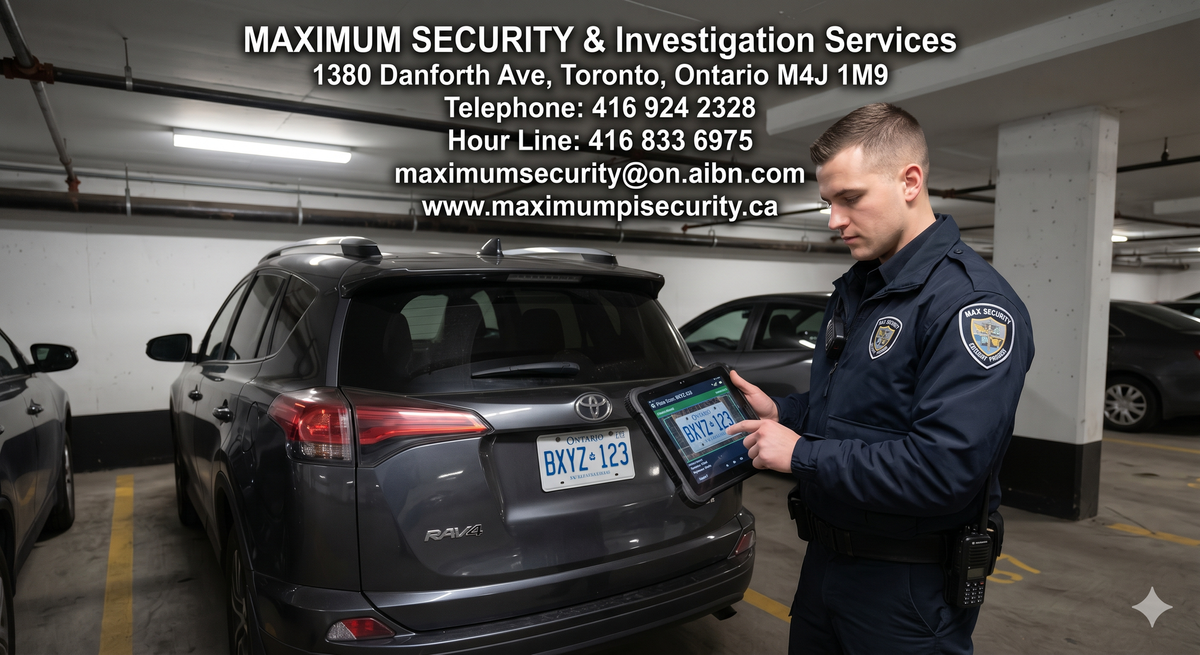
When a resident has a guest arriving, the resident must log into the building's digital portal via their smartphone, enter their guest's license plate number, and select the duration of the stay. When the uniformed security guard begins their parking patrol, they utilize a specialized digital tablet equipped with License Plate Recognition (LPR) software or a manual digital search function. The guard walks the visitor lot, scanning plates. If a vehicle is not registered in the real-time database, it is instantly flagged as a violator. This system eliminates the "I forgot to put the pass on my dash" excuse, as the authorization is tied directly to the license plate itself.
2. Routine Subterranean Patrols and Deeded Spot Protection
Parking enforcement extends far beyond the above-ground visitor lot. In a massive Mississauga high-rise, the underground garage frequently spans three or four subterranean levels containing hundreds of vehicles.
A critical issue arises when a resident arrives home at 6:00 PM to find a complete stranger parked in their privately deeded underground parking spot. This leads to intense resident-on-resident conflict. The security guard protocol must include a rapid-response mechanism for deeded spot violations. If a resident reports an unauthorized vehicle in their spot, the guard descends into the garage, verifies the resident's ownership of the spot against the master building manifest, and immediately tags the offending vehicle. Furthermore, routine subterranean patrols allow the guard to monitor for vehicles that are leaking hazardous oil, storing combustible materials, or lacking valid insurance plates, ensuring the garage remains compliant with property standards.
3. Accessible Parking and Fire Route Enforcement
The most rigid enforcement actions are reserved for life-safety and accessibility violations. Individuals who illegally park in designated accessible (handicap) parking spaces or idle in marked exterior fire routes create severe hazards and human rights violations.
Security guards must be instructed to operate with a zero-tolerance policy for these specific zones. If a food delivery driver leaves their car idling in the fire route to run up to a residential floor, the guard must immediately intercept the vehicle, document the license plate, and issue an infraction or a formal warning. Ensuring these critical lanes remain unobstructed is the primary life-safety mandate of the exterior patrol.
Legal Realities: MLEO Certification and Towing in Mississauga
One of the most complex aspects of condominium parking management is understanding the legal mechanics of actually penalizing violators or removing vehicles from the property. A security guard cannot simply chain a car to a tow truck on a whim; they must operate under strict municipal and provincial laws.
The Power of Municipal Law Enforcement Officer (MLEO) Status
In the City of Mississauga, private security guards can be trained and certified as Municipal Law Enforcement Officers (MLEO) strictly for the purpose of issuing municipal parking infractions on private property.
When a condo board partners with a security agency that utilizes MLEO-certified guards, it completely changes the enforcement dynamic. If the MLEO-certified guard scans a vehicle in the visitor lot and finds it unregistered, they do not leave a meaningless warning note. They issue an official City of Mississauga parking ticket (typically ranging from $40 to $100 depending on the infraction type, such as parking in a fire route vs. parking over the time limit).
This ticket is legally binding. The fines go directly to the municipality, but the psychological impact on the violator is massive. Once an individual receives a formal city ticket that prevents them from renewing their driver's license until paid, they will never abuse your visitor parking lot again. This is the ultimate, non-confrontational deterrent.
The Private Property Towing Protocol
If ticketing is insufficient (for example, if a vehicle has been abandoned in the visitor lot for three weeks), the condominium board must escalate to towing. However, under the Ontario Trespass to Property Act and local municipal bylaws, the towing process must be heavily documented to protect the condo corporation from lawsuits claiming vehicle theft or damage.
The security guard is the authorized agent of the condo board responsible for managing the tow. The strict protocol requires the guard to:
- Verify the vehicle is unauthorized and has exceeded all warning periods.
- Photograph the vehicle comprehensively from all four sides to document pre-existing damage (protecting the corporation if the owner claims the tow truck scratched the bumper).
- Fill out a formal "Tow Authorization Form" authorizing a licensed, municipally approved towing vendor to remove the vehicle.
- Log the tow in the daily shift report, ensuring the concierge desk can inform the furious owner exactly where their car is impounded when they eventually come looking for it.
By utilizing a licensed security professional to execute this legally complex procedure, the condo board entirely insulates itself from civil liability regarding the removal of private property. For operations evaluating similar exterior compliance protocols for non-residential holdings, exploring random mobile guard checks for corporate buildings in Vaughan offers highly relevant tactical frameworks.
Commercial Procurement: Sourcing Parking Enforcement Guards in Peel Region
Acquiring highly trained, MLEO-certified security coverage for a residential condominium requires a realistic understanding of commercial agency pricing structures across Peel Region. Condominium boards cannot evaluate security proposals based on basic minimum-wage expectations. To field a guard capable of managing digital enforcement software, de-escalating angry residents, and issuing legally binding municipal tickets, a legitimate security agency must recruit premium talent.
In the 2026 Ontario market, compliant security agencies price these premium contracts to cover extensive corporate overhead, including multi-million-dollar commercial general liability insurance, comprehensive WSIB clearings, and the administrative backend required to maintain municipal MLEO licensing.
For residential high-rises and sprawling townhouse communities across Mississauga, condo boards should budget for the following agency bill rates:
- Dedicated Residential Security/Parking Guard (Tier 1): Billed at $32.00 to $42.00 per hour (CAD). This involves a highly polished, customer-service-oriented guard deployed to manage the front desk, execute strict access control, and conduct routine manual foot patrols of the underground garage and visitor lots.
- MLEO-Certified Parking Enforcement Specialist: Billed at $36.00 to $48.00 per hour (CAD). This is a specialized guard carrying municipal ticketing authority. They are typically deployed specifically during peak abuse hours (e.g., 6:00 PM to 2:00 AM) to strictly enforce the visitor lot, issue city infractions, and authorize legal tows.
- Randomized Mobile Patrol Check (Vehicle-Based): Billed at $45.00 to $65.00 per individual site visit (CAD). If the condo board cannot afford a dedicated full-time guard, they can hire a mobile security vehicle to randomly drop by the property three times a night specifically to scan the visitor lot and ticket unauthorized vehicles.
Hiring an organization that quotes rates significantly below these commercial baselines—such as $22.00 per hour—is a direct indication that the provider is utilizing untrained personnel without MLEO certification. If you hire a cut-rate security company and their guard illegally authorizes a tow without proper documentation, the vehicle owner can successfully sue your condominium corporation for thousands of dollars. To understand how to properly vet B2B vendors and structure comprehensive safety frameworks, reviewing our guide on alarm response security services for small businesses in Oakville provides excellent insights into managing specialized guard responses.
If your Mississauga condominium or sprawling residential townhouse complex requires an unyielding line of defense to eliminate parking abuse and enforce community bylaws, establishing professional protection is straightforward. Property managers can easily connect with verified B2B vendors to request a custom security quote from Maximum PI Security to deploy MLEO-certified personnel, manage digital visitor logs, and secure valuable community assets.
Nitty-Gritty Condo Parking Realities
Can a security guard authorize the towing of a resident's car if their license plates are expired?
Yes, but it depends entirely on the condominium's specific declaration and rules. Most standard Ontario condo declarations state that all vehicles parked on the property must be roadworthy, actively insured, and display valid registration. If a resident decides to use their underground spot to store a broken-down, uninsured project car with expired plates, they are violating the bylaws. The security guard will document the violation, the property manager will issue formal warning letters to the unit owner, and if the vehicle is not removed or insured, the guard can legally authorize the tow at the owner's expense.
What happens if a food delivery driver refuses to move out of the fire route?
If a delivery driver parks in the fire route, turns on their hazard lights, and refuses a direct verbal command from the security guard to move, the guard's protocol is strict documentation, not physical force. The guard will not physically wrestle the driver or attempt to block their vehicle. The guard will immediately photograph the vehicle's license plate while it is parked in the marked fire route. If the guard is MLEO-certified, they will issue the high-value municipal fire route infraction directly to the vehicle. If not, the photographic evidence is submitted to Mississauga By-Law Enforcement, ensuring the driver faces heavy penalties without the guard engaging in a dangerous physical altercation.
Can a security guard put a "boot" (wheel clamp) on an unauthorized car in the visitor lot?
No. Under current Ontario law and standard municipal bylaws, private security guards and private property owners are heavily restricted from utilizing physical wheel clamps (boots) to hold a vehicle hostage for a release fee. Booting vehicles on private property frequently leads to massive civil liability and aggressive, violent confrontations. The legally protected and highly effective strategy is issuing formal municipal parking tickets (via an MLEO guard) or authorizing a licensed tow truck to completely remove the vehicle from the property to a municipal impound lot.
Frequently Asked Questions
What are the peak times for visitor parking abuse in Mississauga condominiums?
Field data indicates that the highest concentration of unauthorized parking occurs during two specific windows. The first is weekday commuter hours (8:00 AM to 5:00 PM), particularly for buildings located near major transit hubs like the Square One bus terminal or Cooksville GO Station. The second is weekend evenings (Friday and Saturday, 7:00 PM to 2:00 AM) when non-residents utilize condo visitor lots for overnight stays or parties.
Does the condominium corporation have to pay the tow truck driver?
No. When a security guard authorizes a legal private property tow, the condominium corporation does not pay the towing invoice. The towing company removes the vehicle to their secure municipal impound lot. To retrieve their vehicle, the individual who illegally parked must pay the towing company the heavy impound and towing fees directly. This makes parking enforcement a highly effective, revenue-neutral strategy for condo boards.
What kind of signage is legally required before a security guard can tow a car?
To legally enforce towing under the Trespass to Property Act and municipal bylaws, the condominium must display clear, highly visible warning signage at every entrance to the parking facility. The signs must explicitly state "Private Property," indicate that unauthorized vehicles will be ticketed and/or towed at the owner's expense, and list the name and phone number of the contracted towing company so the violator knows who to call to retrieve their vehicle. Your contracted security agency will typically audit your signage before beginning enforcement to guarantee legal compliance.
About the Author
Jeff Calixte is an online exclusive content sell strategist with a deep background in tracking local asset protection data, analyzing Southern Ontario labor rates, and outlining real operational deployment structures across the Greater Toronto Area.
Sources
- Ontario Ministry of the Solicitor General - Private Security and Investigative Services Act Regulations
- City of Mississauga - Parking Enforcement and Private Property Towing Bylaws
- Condominium Act, 1998, S.O. 1998, c. 19
Note
Commercial bill rates, guard wages, deployment conditions, and vendor availability can vary widely by province, municipality, season, and project scope. All pricing estimates, labor figures, and career examples in this guide are approximations based on current Ontario market data. Always confirm contract details, licensing compliance, and specific rate quotes directly with your chosen service provider or employer before finalizing any agreements.