Uniformed Retail Security Guards: Shoplifting Deterrence Strategies
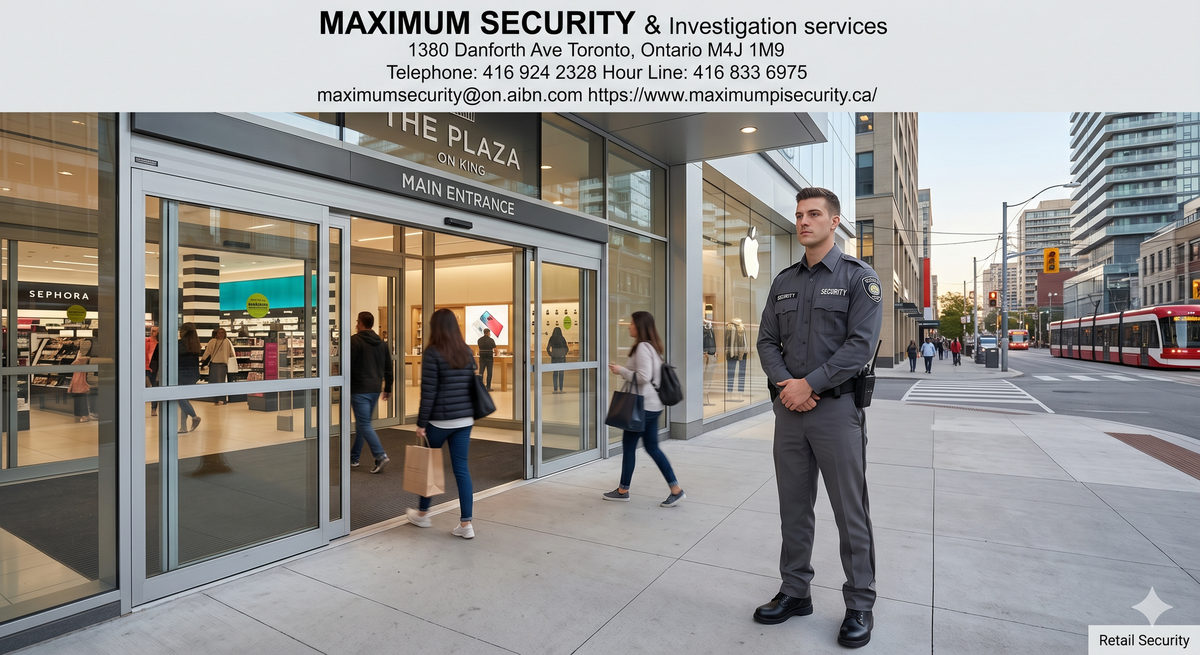
Operating a successful retail brick-and-mortar footprint across the Greater Toronto Area demands an aggressive approach to asset protection and loss prevention. From high-traffic shopping centers like the Eaton Centre and Yorkdale to dense commercial plazas along the Danforth and major boutique corridors in downtown neighborhoods, retail operators are fighting an uphill battle against rising inventory shrinkage. In recent years, shoplifting has shifted from minor, opportunistic incidents into highly organized retail crime (ORC) networks that systematically target inventory for quick liquidation on digital marketplaces.
Relying entirely on passive electronic article surveillance (EAS) tags, unmonitored security cameras, or basic employee training leaves a retail store highly vulnerable to bold, daytime theft rings. For a retail store owner, regional operations manager, or corporate loss prevention director, protecting profit margins requires implementing a proactive security strategy built around a visible, professional human presence. Deploying trained, uniformed retail security guards allows businesses to regain control over their floor spaces, deter criminal syndicates, protect front-line retail staff, and create a welcoming environment for paying customers.
The Financial Reality of Modern Retail Shrinkage
Inventory shrinkage represents an immediate threat to the thin margins of Canadian retail operations. When a store loses high-ticket inventory out the front door, the business cannot simply absorb the loss; it must generate thousands of dollars in additional sales just to recover the raw wholesale cost of the stolen merchandise.
Consensus Analysis: Passive Electronic Article Surveillance vs. Visible Uniformed Guards
When building a loss prevention budget, store managers frequently debate whether to invest in advanced electronic security tags or deploy a visible, uniformed security presence at the front entrance.
The Verdict:
- Avoid This: Relying exclusively on passive electronic security tags, door buzzers, or basic overhead cameras. Organized retail crime groups routinely utilize lined booster bags or magnetic detachers that completely bypass electronic sensors without triggering a single alarm, allowing them to exit undetected.
- Buy This: Station a professional, crisply uniformed security guard directly at the primary storefront entrance and exit zones. A visible human presence creates an immediate psychological barrier for shoplifters, disrupting their exit strategy and forcing theft groups to completely bypass your storefront in favor of softer, unmonitored targets.
Calculating the True Overhead of Retail Theft Operations
The true financial impact of retail theft extends far past the direct cost of a stolen designer jacket, high-end electronic device, or bulk cosmetic shipment. When a retail location becomes a frequent target for open shoplifting, the entire operational health of the store declines rapidly.
Frequent, unchecked theft creates a stressful environment for retail workers, driving high employee turnover rates and increasing corporate recruitment and training expenses. If store staff feel unsafe challenging aggressive shoplifters, morale plummets, directly leading to lower customer service standards and declining sales volumes.
| Loss Component | Unsecured Retail Store Environment | Fortified Uniformed Guard Layout |
|---|---|---|
| Direct Inventory Asset Loss | $18,500 - $32,000 (CAD) | $0.00 (Prevented Theft) |
| Employee Turnover & Re-Hiring Costs | $6,500 (CAD) | $0.00 (Stable Workplace) |
| Commercial General Liability Claims | $15,000+ (CAD Deductibles) | $0.00 (Managed Incidents) |
| Customer Foot Traffic Decline | Estimated 12% drop in sales | $0.00 (Maintained Traffic) |
| Total Estimated Financial Impact | $40,000 - $53,500+ (CAD) | $0.00 |
Furthermore, if a retail store relies on untrained staff to intercept shoplifters, the business faces massive legal liabilities. Improperly handling a suspected shoplifter can trigger severe civil lawsuits for false imprisonment, defamation, or personal injury, with legal deductibles and settlement fees routinely exceeding tens of thousands of dollars. Investing in professional, licensed guarding assets is a predictable, mathematically superior approach that protects your corporate bottom line while shielding your business from severe legal exposures.
Retail operators looking to understand how storefront security integrates with broader commercial protection guidelines across Southern Ontario should review our foundational manual on 2026 construction site security guidelines for GTA contractors to verify baseline risk management frameworks.
Designing an Advanced Storefront Loss Prevention Blueprint
Eliminating organized retail crime demands a strategic, active security layout that addresses storefront vulnerabilities during both peak operational hours and late-night closing buffers.
1. Strategic Position Profiling: The "First Impression" Deterrent
Your primary retail security asset must be positioned carefully to maximize their visual deterrence. Station your uniformed guard within the immediate entrance foyer, directly adjacent to the main cash wraps and electronic security pedestals. This positioning provides the guard with a complete, unobstructed line of sight across the entire sales floor and main entry points.
The presence of a sharp, alert security officer signals to every visitor that the store is actively managed and protected. For premium retail locations or boutique storefronts seeking an elite, professional human presence to protect luxury inventory without compromising customer service standards, incorporating specialized guarding models like those detailed in our guide on custom home renovation security guards in Lawrence Park provides excellent context for premium concierge-style protection.
2. Implementing the "De-Escalation First" Tactical Framework
Modern retail security guards must prioritize advanced verbal de-escalation techniques over physical force. When an incident occurs on the sales floor, a trained guard uses non-threatening body language and professional verbal commands to contain the situation quickly before it can escalate into a dangerous physical altercation.
If a suspect attempts to exit with concealed merchandise, the guard acts as a calm, authoritative presence. They request the return of the store's property politely yet firmly, allowing the business to recover its inventory safely while minimizing disruptions to paying customers. For properties experiencing elevated rates of late-night property damage or aggressive trespassing near public sidewalks, combining storefront guarding with the perimeter protocols in our guide on pre-construction site fencing and asset protection in downtown Toronto ensures boundaries remain highly secure.
3. Integrating Randomized Mobile Security Audits
For retail operations, corporate strips, or multi-unit plazas where budgets cannot support a permanent, full-time static security presence, integrating a dedicated mobile security patrol service is an exceptional alternative. A mobile security unit does not remain inside a single storefront continuously; instead, a professional patrol officer in a marked security vehicle arrives at your retail property at completely randomized intervals throughout high-risk business hours and overnight closing windows.
During each site visit, the mobile patrol officer checks perimeter doors, monitors parking areas for suspicious vehicles, and ensures that rear loading docks remain completely secure. The unpredictable nature of these checks thoroughly disrupts the planning of local theft operations and smash-and-grab groups. For property managers looking to evaluate the performance metrics and financial differences between static coverage and shared vehicle services, studying our comprehensive breakdown on hiring live guards vs. mobile patrols for Vaughan residential developments provides excellent guidance for structuring multi-site protection budgets.
Commercial Procurement: Sourcing Verified Retail Guarding Services
Acquiring professional security guard coverage for a retail storefront requires a realistic understanding of commercial agency pricing structures across Southern Ontario. Store managers often make the mistake of evaluating security proposals based on basic minimum-wage expectations, completely overlooking the substantial corporate infrastructure required to operate a legitimate, fully licensed security guard business. In the 2026 Ontario market, a compliant security agency must operate under the strict guidelines of the Private Security and Investigative Services Act (PSISA), pricing contracts to cover extensive corporate overhead, including multi-million-dollar commercial general liability insurance, comprehensive WSIB clearings, vehicle fleet maintenance, and 24/7 centralized command centers.
For active retail operations or shopping plazas across the GTA, commercial procurement teams should budget for the following agency bill rates:
Retail Security Sourcing Rates (GTA Market)
| Service Classification | Required Guard Qualifications | Commercial Hourly Client Bill Rate (CAD) | Intended Retail Application |
|---|---|---|---|
| Static Uniformed Retail Guard (Tier 1) | PSISA Licensed, First Aid Certified, customer-service oriented, basic digital logs. | $38.00 - $48.00 / hr | Standard storefronts, grocery stores, and commercial retail plazas. |
| Elite Loss Prevention Specialist (Tier 2) | Plainclothes or tactical uniform, advanced legal arrest training, manifest auditing. | $45.00 - $58.00 / hr | Luxury boutiques, high-theft electronics retailers, and flagship department stores. |
| Randomized Mobile Vehicle Patrol (Tier 3) | Fully equipped GPS-tracked patrol vehicle, rapid alarm response integration. | $65.00 - $90.00 / hr (or $45 - $75 per individual check) | Strip malls, open-air retail centers, and after-hours property checks. |
Hiring an organization that quotes rates significantly below these commercial baselines—such as $22.00 to $25.00 per hour—is a direct indication that the provider is cutting critical compliance corners, leaving your business exposed to massive legal vulnerabilities. Understanding the foundational legal frameworks outlined in construction site security guard requirements in North York can protect your business from these severe compliance failures.
If your active storefront, luxury boutique, or retail shopping center requires an unyielding line of defense to eliminate inventory shrinkage, establishing professional protection is straightforward. Store owners and corporate operations managers can easily connect with verified field operators to request a custom security quote from Maximum PI Security to deploy certified personnel, manage primary entrances, and secure valuable inventory assets against shoplifting threats.
Legal Realities and Compliance Under the Criminal Code of Canada
Deploying private security guards within a retail environment requires strict adherence to Canadian law and provincial regulations to protect the business from severe civil lawsuits. Under section 494 of the Criminal Code of Canada, a private security guard (acting as an authorized agent of the property owner) possesses the legal power to execute a citizen's arrest if they witness an individual committing an indictable offense—such as theft over $5,000 or mischief—on or in relation to the property.
However, to legally execute an arrest for shoplifting, the security guard must maintain continuous, uninterrupted surveillance of the suspect from the exact moment they select the merchandise to the moment they clear the final point of sale without paying. The guard must establish five distinct legal steps:
- Witness the suspect select the item off the display shelf.
- Witness the suspect conceal the item within their clothing or a bag.
- Maintain uninterrupted visual surveillance of the suspect throughout their entire time in the store.
- Witness the suspect bypass all open cash registers and points of sale.
- Intercept the suspect completely outside the store perimeter on private sidewalk property.
If a guard fails to maintain continuous observation for even a few seconds, executing an arrest introduces massive legal liabilities, as the suspect may have discarded the merchandise in a blind spot. Sourcing security through a verified firm adhering to strict training baselines—such as those detailed in our guide on protecting heavy machinery from cargo theft in Mississauga construction zones—is a fundamental risk-management step to protect your business from unlawful detention claims.
Nitty-Gritty Retail Security Realities
Can a retail security guard legally search a customer's backpack if the door alarm rings?
A retail security guard cannot physically force a customer to open their personal bags or backpack for inspection unless the customer explicitly consents to the search, or the guard has witnessed the full legal steps required to execute a formal shoplifting arrest. However, a retail store has the full legal right to establish a "Condition of Entry" policy, requiring all visitors to check large bags at the front counter before entering the sales floor. If a customer refuses a voluntary bag check when leaving and no theft was directly witnessed, the guard must let them leave, but they can formally ban that individual from ever re-entering the private property.
What should a retail guard do if a shoplifter becomes physically aggressive when challenged?
If a suspected shoplifter becomes physically aggressive or pulls out a weapon—such as a knife, syringe, or bear spray—the guard’s strict operational protocol is immediate de-escalation, tactical withdrawal, and law enforcement escalation. The guard must prioritize the physical safety of store employees and customers over the recovery of commercial merchandise. The guard will secure the immediate area, safely document the suspect’s physical description and escape direction via a mobile reporting application, and instantly contact 911 to dispatch the local police service for formal intervention.
Are retail stores legally responsible if a guard injures a suspect during an interception?
Yes. Under the legal principle of vicarious liability, a retail store can be held civilly responsible for the actions of security personnel operating on their premises. If a guard utilizes improper or excessive physical force against a suspected shoplifter, the store can face direct lawsuits for personal injury and assault. This is why corporate procurement teams must partner exclusively with professional, fully insured security agencies that carry extensive commercial general liability insurance policies and mandate rigorous use-of-force training for all deployed personnel.

Frequently Asked Questions
What are the peak operational hours for organized retail crime in the GTA?
Field records show that organized retail theft groups selectively target stores during mid-afternoon windows between 1:00 PM and 4:00 PM, or during the final twilight hour right before closing. These periods feature either maximum customer foot traffic to provide cover, or minimal floor staffing to minimize the risk of detection.
Should retail stores utilize plainclothes loss prevention officers or uniformed guards?
The optimal choice depends on your specific business goals. If your primary objective is to stop shoplifting attempts before they happen and create a safe environment for your customers, a visible, uniformed security guard is highly effective. If your goal is to apprehend active theft rings and build formal legal cases for police prosecution, incorporating plainclothes loss prevention officers provides excellent covert auditing capabilities.
How do we secure our rear loading docks from opportunistic theft during deliveries?
To protect rear shipping gates and loading docks during active delivery windows, ensure your on-site security guard reviews all inbound manifests, verifies driver identification, and maintains complete visual control over the open bay doors. When no deliveries are actively occurring, all rear loading dock doors must remain completely closed, locked, and secured with heavy-duty internal deadbolts.
About the Author
Jeff Calixte is an online exclusive content sell strategist with a deep background in tracking local asset protection data, analyzing Southern Ontario labor rates, and outlining real operational deployment structures across the Greater Toronto Area.
Sources
- Criminal Code of Canada, R.S.C. 1985, c. C-46 - Section 494 Arrest Standards
- Ontario Ministry of the Solicitor General - Private Security and Investigative Services Act Regulations
- Trespass to Property Act, R.S.O. 1990, c. T.21
Note
Commercial bill rates, guard wages, deployment conditions, and vendor availability can vary widely by province, municipality, season, and project scope. All pricing estimates, labor figures, and career examples in this guide are approximations based on current Ontario market data. Always confirm contract details, licensing compliance, and specific rate quotes directly with your chosen service provider or employer before finalizing any agreements.